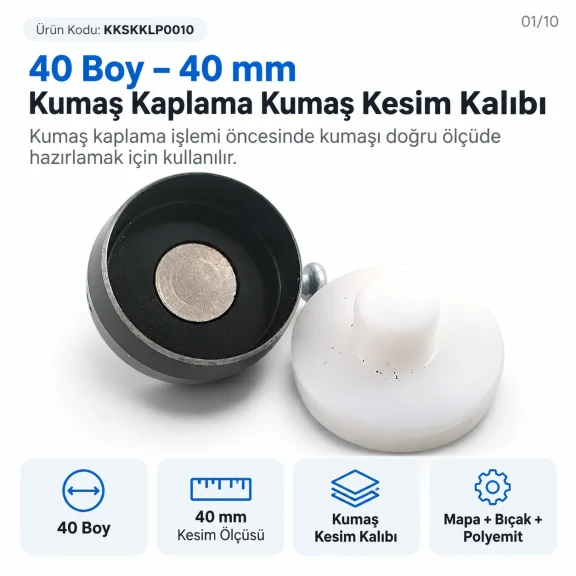
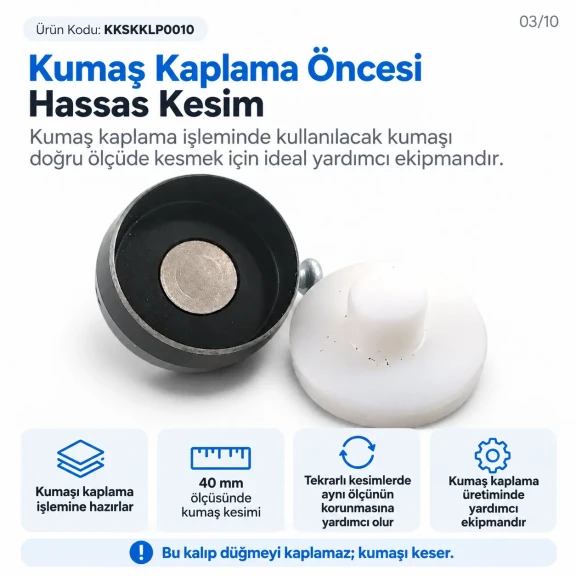
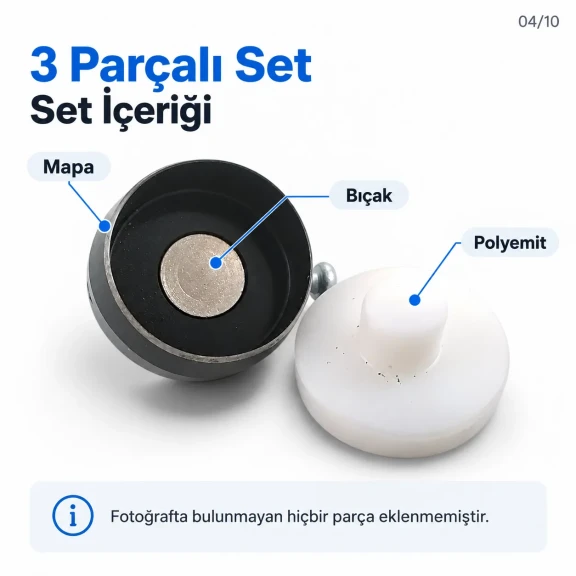
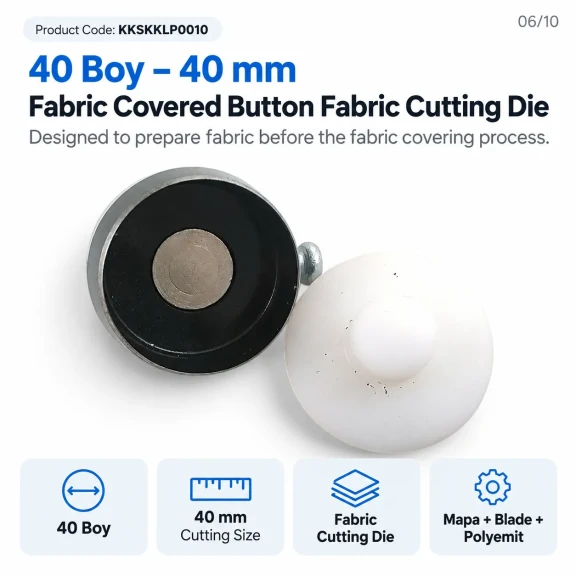
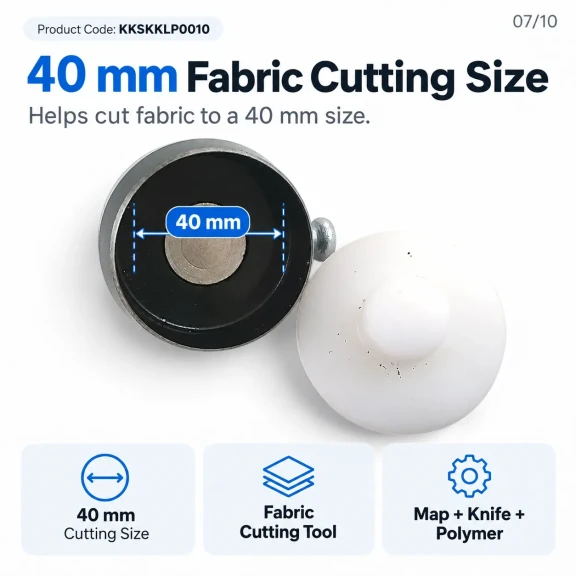
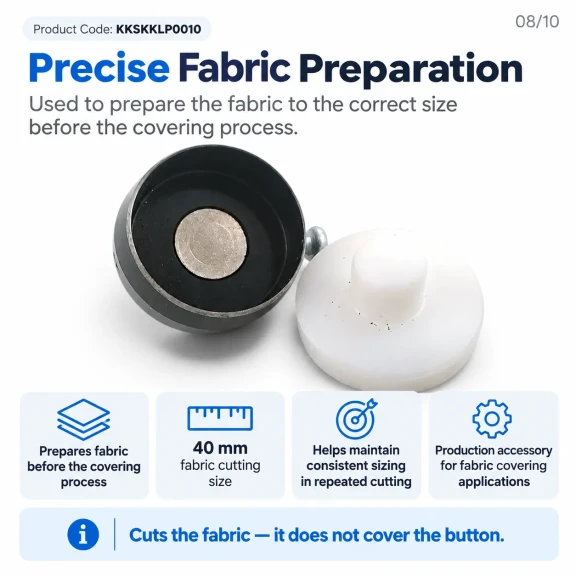
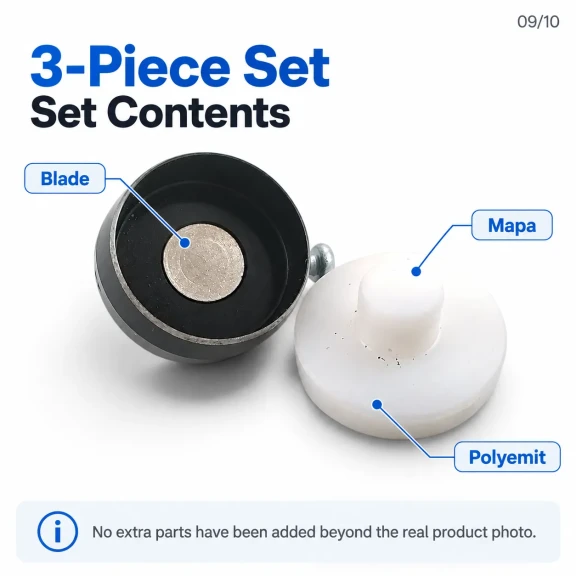
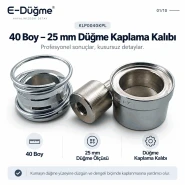
40L 40 mm / 1.57 in Fabric Cutting Die for Covered Buttons KKSKKLP0010 is a pre-covering tool used to prepare 40 mm / 1.57 in circular fabric pieces for fabric-covered button production. The set consists of a Mapa, cutting blade and Polyemit base. It cuts fabric only and does not form the finished button. This E-Düğme English version separates measurements, function and selection risks for technical purchasing.
What the 40 mm / 1.57 in measurement means
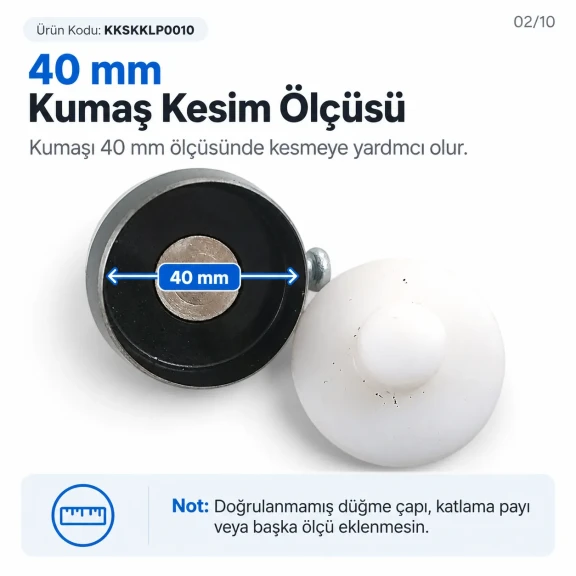
The 40 mm / 1.57 in figure is the target diameter of the fabric circle made by this tool. It should not automatically be read as the finished outside diameter of the covered button. 40L is the button-size class used for this product family. Record both values with their units to avoid confusing a size class with a cutting dimension.
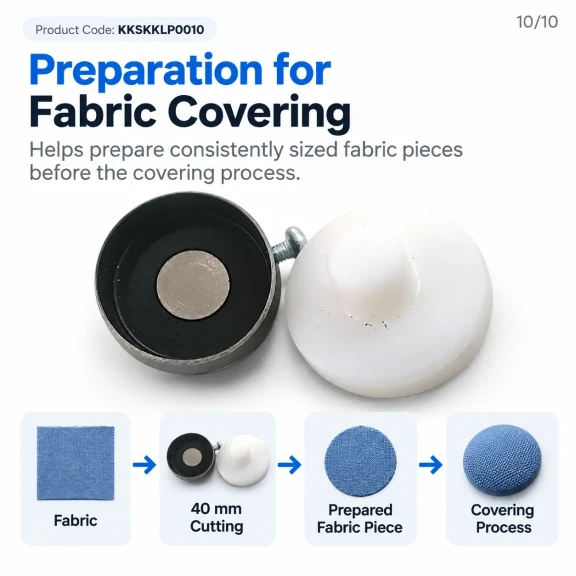
Where it sits in the production sequence
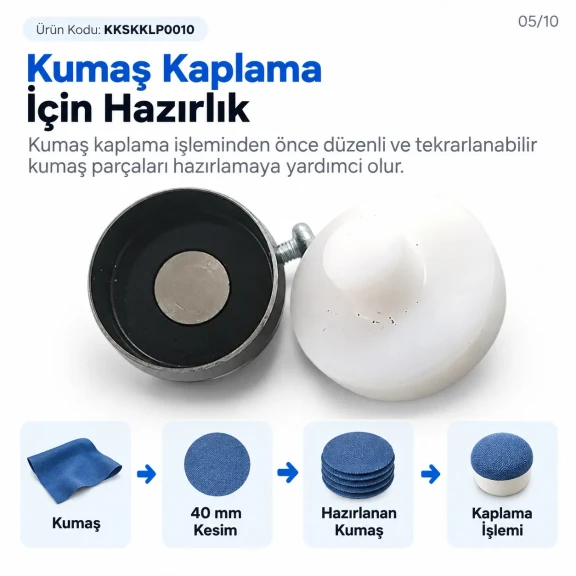
Covered-button work is easier to control when fabric cutting and button covering are treated as separate operations. This tool belongs to the preparation stage. After the circle is cut, the fabric moves to a separately verified covering die with the button components.
Technical summary
| Tool type | Fabric cutting die |
| Size class | 40L |
| Measurement | 40 mm / 1.57 in |
| Primary operation | Fabric preparation before covering |
| Set contents | Mapa + cutting blade + Polyemit base |
| Recorded weight | 300 g |
Why tool identification matters
Covered-button tooling can look similar across sizes and operations. A visual match is not enough to confirm that two tools are interchangeable. Check the model code, operation, size class and measurement together. If your actual need is to form fabric around button parts, a cutting die is not the final tool you need. Clear identification also helps teams with multiple operators or shifts.
Fabric remains a production variable
Thickness, stretch, weave or knit construction, surface treatment, pattern direction and layer count can all change material behavior. Tool measurement may stay constant while textile response changes. This is why an approved setup for one fabric should not automatically be transferred to a substantially different fabric without a sample check.
Sample before committing the full quantity
Cut a small group from the actual production fabric and inspect the circle shape, edge condition and any sign of stretching. Then move at least one sample through the separate covering operation so the complete workflow is validated rather than only the loose fabric circle.
Pattern placement and fabric direction
Stripes, checks, logos, printed motifs and directional nap may require positioning decisions before the operation begins. Decide what should appear on the visible button face and keep orientation consistent throughout the batch. The die controls a mechanical stage, but visual placement remains part of the production plan.
Repeat-order documentation
For repeat production, record 40L, 40 mm / 1.57 in, model KKSKKLP0010, the textile reference and the complementary tool used in the next or previous stage. Explicit job notes reduce reliance on memory and make it easier for another operator to reproduce an approved setup. A changed fabric lot should still be validated with a short sample.
Press and machine compatibility
Universal press compatibility should not be assumed from the product name. Connection geometry, working height and mechanical arrangement can vary. A tool that resembles another die may still require a different interface. Verify physical and working compatibility with the actual press or machine before production. This listing intentionally avoids unsupported universal-fit claims.
Workshop organization
When several sizes are used, store and label tooling by both operation and measurement. Keep the Mapa, cutting blade and Polyemit base together as one set and avoid mixing pieces from different sizes. A labeled storage system also makes missing or misplaced components easier to notice.
Quality-control points
Check circle geometry, edge condition, fabric distortion and layer shift if more than one layer is being prepared. Periodic checks are useful during longer runs because material and workstation conditions can change.
Limits and responsible use
This description does not claim that the tool will behave identically with every textile, fit every press, or eliminate the need for setup verification. Do not make unverified modifications that change geometry or working dimensions. If performance changes, check the textile, workstation, tool cleanliness and equipment setup before altering the tool.
Pre-order checklist
- Confirm the 40L size class.
- Confirm the 40 mm / 1.57 in measurement.
- Make sure you need a fabric cutting die rather than only a covering die.
- Verify press or machine compatibility.
- Plan a sample using the actual production textile.
- Plan motif position and direction for patterned fabric.
Frequently asked questions
What is the main purpose of this tool?
It prepares 40 mm / 1.57 in circular fabric pieces before button covering.
Are 40L and 40 mm the same measurement?
No. The size class and the metric dimension carry different technical meanings.
Does it cover the button?
No. It cuts fabric only; covering requires separate tooling.
Will it fit every press?
Universal fit should not be assumed. Verify physical and working compatibility with your equipment.
Should a new fabric be tested?
Yes. Fabric construction, thickness and stretch can change production behavior.
Is setup documentation useful for repeat orders?
Yes. Record the size, textile, model code and complementary tooling for future production.
Additional workshop note 1
For repeat orders, record the 40L classification, 40 mm / 1.57 in measurement, textile reference, and the next tool used in the workflow. Written setup notes are more reliable than memory when multiple operators share the same production area. Explicit units also prevent the size class from being confused with a millimeter dimension.
Additional workshop note 2
A successful setup with one textile should not be treated as automatic approval for another. Stretch, thickness, weave, coating, and layer count can change how material behaves. A short sample cycle with the actual production fabric is the safest way to confirm the working sequence before committing a larger quantity.
Additional workshop note 3
If several similar dies are stored together, label both the function and measurement. Keeping cutting tools separate from covering tools makes the workflow easier to understand for a new operator and helps prevent components from different systems from being mixed.
Additional workshop note 4
For repeat orders, record the 40L classification, 40 mm / 1.57 in measurement, textile reference, and the next tool used in the workflow. Written setup notes are more reliable than memory when multiple operators share the same production area. Explicit units also prevent the size class from being confused with a millimeter dimension.
Additional workshop note 5
A successful setup with one textile should not be treated as automatic approval for another. Stretch, thickness, weave, coating, and layer count can change how material behaves. A short sample cycle with the actual production fabric is the safest way to confirm the working sequence before committing a larger quantity.
Additional workshop note 6
If several similar dies are stored together, label both the function and measurement. Keeping cutting tools separate from covering tools makes the workflow easier to understand for a new operator and helps prevent components from different systems from being mixed.
Additional workshop note 7
For repeat orders, record the 40L classification, 40 mm / 1.57 in measurement, textile reference, and the next tool used in the workflow. Written setup notes are more reliable than memory when multiple operators share the same production area. Explicit units also prevent the size class from being confused with a millimeter dimension.
Additional workshop note 8
A successful setup with one textile should not be treated as automatic approval for another. Stretch, thickness, weave, coating, and layer count can change how material behaves. A short sample cycle with the actual production fabric is the safest way to confirm the working sequence before committing a larger quantity.
Additional workshop note 9
If several similar dies are stored together, label both the function and measurement. Keeping cutting tools separate from covering tools makes the workflow easier to understand for a new operator and helps prevent components from different systems from being mixed.
Additional workshop note 10
For repeat orders, record the 40L classification, 40 mm / 1.57 in measurement, textile reference, and the next tool used in the workflow. Written setup notes are more reliable than memory when multiple operators share the same production area. Explicit units also prevent the size class from being confused with a millimeter dimension.
Additional workshop note 11
A successful setup with one textile should not be treated as automatic approval for another. Stretch, thickness, weave, coating, and layer count can change how material behaves. A short sample cycle with the actual production fabric is the safest way to confirm the working sequence before committing a larger quantity.
Additional workshop note 12
If several similar dies are stored together, label both the function and measurement. Keeping cutting tools separate from covering tools makes the workflow easier to understand for a new operator and helps prevent components from different systems from being mixed.
Additional workshop note 13
For repeat orders, record the 40L classification, 40 mm / 1.57 in measurement, textile reference, and the next tool used in the workflow. Written setup notes are more reliable than memory when multiple operators share the same production area. Explicit units also prevent the size class from being confused with a millimeter dimension.
Additional workshop note 14
A successful setup with one textile should not be treated as automatic approval for another. Stretch, thickness, weave, coating, and layer count can change how material behaves. A short sample cycle with the actual production fabric is the safest way to confirm the working sequence before committing a larger quantity.










 Not sure about the size?Ask before you order — we'll help you pick the right size and matching setting tool.We're online · Mon–Fri 09:00–18:00, Sat 09:00–13:00 (GMT+3)Ask on WhatsApp☎ +90 530 520 40 09Get a bulk quote →★ 4.6 customer rating · 2,100+ orders · office & store in Istanbul


-s1351%20(1%20(6).jpeg-185x185.webp "10 mm 0,39")


