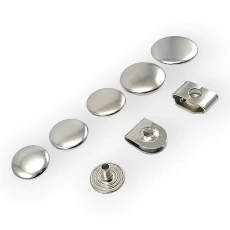
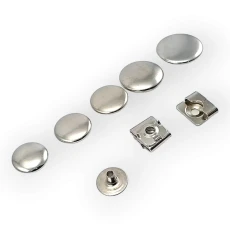
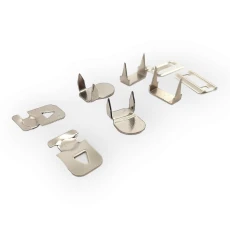
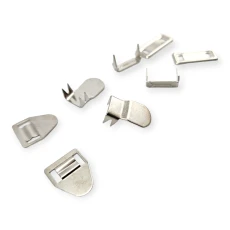
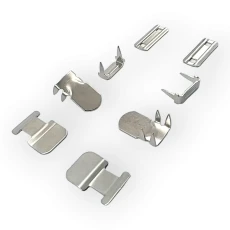
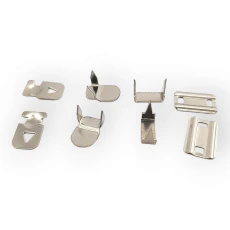
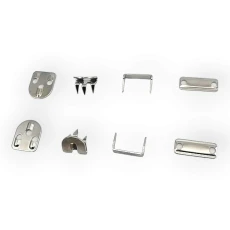
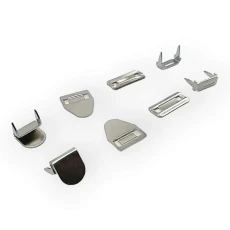
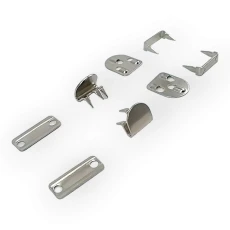
Trouser and skirt hook-and-bar closures are garment fastening components used around waistbands and other low-profile closure points. The live category includes brass and stainless-steel-labelled options, standard and large-format models, and compact Bambino variants. Many products use a four-piece set construction. Selection should be based on the model code, set geometry, fabric build-up and the compatible setting die rather than appearance alone.
Where trouser and skirt hooks are used
These closures are commonly installed at the top of a trouser or skirt opening, near the waistband and zipper area, where a compact fastening point is required. They can also be relevant to suit trousers, uniforms and other garment constructions that use a hook-and-bar style waist closure. They are particularly useful to apparel manufacturers, alteration specialists, sample rooms and production teams that need the same closure system to be repeated reliably.
Live product families in this category
| Family | Live examples | Selection focus |
|---|
| Standard four-piece sets | Ak00050P, Ak00050PR and related variants | Material, set geometry and compatible die |
| Large-format four-piece set | AK00010PR | Physical scale and garment construction |
| Bambino compact family | Ak00102PR, Ak00103PR | Model-specific setting-die match |
| Additional brass variants | Ak00101PR, Ak00247PR, Ak00822PR, Ak00833PR | Match by exact model code |
Availability, pack quantity and option status can change, so current commercial details should always be checked on each product page.
Brass and stainless options
The category is not limited to a single material. Live products include brass-labelled models and a stainless-labelled model. Material should therefore be treated as one selection factor among several. Garment specification, required surface appearance, production method and the matching die all matter. Two closures that look similar are not automatically interchangeable.
What does a four-piece set mean?
Many trouser and skirt hooks in this category are described as four-piece sets. The closure is formed by complementary components that must work together as the intended model. Mixing a hook or backing component from another family may change alignment or closing behaviour. For repeat production, store the components by model code and treat the full set as one production system.
Setting closure versus sew-on hook and eye
A prong-set trouser hook and a classic sew-on hook-and-eye can serve a similar fastening purpose but use different attachment methods. If your project requires a sewn closure, review the sew-on hook and eye / frog fastening range. If your project requires a press-applied trouser or skirt hook, focus on the model-specific four-piece systems in this category.
Why the correct setting die matters
The setting die supports alignment and controlled pressure during installation. Similar-looking hooks may use different underside geometry, so die selection should not be based only on visual size. Compare the product model and the die model before production. Browse setting dies and application tools for the matching trouser and skirt hook tooling.
Fabric and waistband construction
The closure is only one part of the system. Fabric layers, interfacing, lining, waistband stiffness and material thickness can change the installation behaviour. A lightweight waistband and a heavily reinforced waistband may not respond in the same way. Test the real production stack before a long run so the prongs, alignment and closing action can be evaluated under realistic conditions.
Use model codes as production references
Codes such as Ak00050P, Ak00050PR, AK00010PR, Ak00101PR, Ak00102PR, Ak00103PR, Ak00247PR, Ak00822PR and Ak00833PR are useful workshop references. They reduce ambiguity when reordering, selecting dies or handing a job to another operator. “The same trouser hook as last time” is much less reliable than a recorded model code and approved sample.
Bambino and large-format choices
Bambino variants represent a compact family, while the large-size model uses a visibly different physical format. Choose according to waistband proportions, garment design and the approved closure construction. The family name should also be retained in tooling records because it may affect which setting die is required.
First-piece approval
Before full production, prepare several samples with the real fabric and the intended die. Check that the hook and bar sit straight, close without excessive force and do not cause unnecessary distortion in the waistband. Once approved, record the model, die, fabric stack and installation direction so the same setup can be reproduced.
Quality-control points for repeat production
- Are all four components from the same model family?
- Is the setting die verified for the exact model?
- Are hook and bar aligned consistently?
- Does the closure open and close without unusual resistance?
- Is the fabric free from tearing, twisting or excessive marking?
- Are operators using the same orientation and tooling across the batch?
Wholesale and repeat-order workflow
For repeat orders, keep the model code, material description, die reference, fabric specification and approved sample together. Current price, stock and pack details must still be checked on the live product page. The E-Düğme category is designed to guide product selection, not to freeze commercial data that may change later.
Common selection mistakes
Typical errors include treating sew-on hooks and press-set trouser hooks as the same product, selecting a die by appearance only, mixing components from different four-piece systems, and starting a large run without testing the actual waistband material. Another mistake is assuming that every item in the category uses the same material. The live range includes more than one material and several model families.
Frequently asked questions
Is a trouser hook the same as a sew-on hook and eye?
No. They may solve a similar closure need, but attachment method and component geometry can differ.
Are all products stainless steel?
No. The live range includes brass-labelled products and a stainless-labelled option.
What does four-piece set mean?
It refers to a closure system built from four complementary parts that should be kept within the same model family.
Do Bambino models require specific tooling?
Tool compatibility should be verified by model code; live Bambino-specific setting dies are available.
Will one setting die fit every hook?
Universal fit should not be assumed. Verify the exact model and physical geometry.
Does fabric thickness matter?
Yes. Fabric, lining and interfacing build-up can affect installation behaviour.
Should I make a sample before production?
Yes. Use the actual fabric stack and approved tooling for first-piece validation.
Are pack size and stock fixed?
No. Check the live product page for current pack, stock and option information.
A practical selection sequence
First decide whether the garment needs a press-set trouser/skirt closure or a sew-on hook-and-eye. Then identify the preferred model family and material, verify the four-piece set, match the compatible die and make a sample with the actual waistband. This sequence reduces the risk of ordering the right-looking closure with the wrong tooling.
What to record on a production card
Record the closure model, material label, die reference, fabric stack and approved sample. These details make repeat orders faster to reproduce and reduce reliance on verbal instructions when operators or shifts change.
Storage and component control
Keep visually similar hook components in labelled bins by model code. Four-piece systems can become difficult to identify after components are mixed, so clear storage is an important part of production control.
Functional checking after setting
After installation, open and close the sample several times and inspect alignment under normal garment movement. The closure should hold as intended without creating unnecessary strain around the waistband.
What to record on a production card
Record the closure model, material label, die reference, fabric stack and approved sample. These details make repeat orders faster to reproduce and reduce reliance on verbal instructions when operators or shifts change.
Storage and component control
Keep visually similar hook components in labelled bins by model code. Four-piece systems can become difficult to identify after components are mixed, so clear storage is an important part of production control.

.jpg-40x40.webp "Magnetic Snaps Buttons")

.jpg-40x40.webp "Prong Snap Fasteners for Baby Clothes")


.jpg-40x40.webp "Curved Snaps Buttons")


.jpg-40x40.webp "Snap Fasteners Half Dome type")
-no5-k0010%20(3).jpg-40x40.webp "Eyetlets")


-K0014.png-40x40.webp "Steel Eyelets and Iron Metal Grommets")

.jpg-40x40.webp "Flat Brass Eyelets and Grommets")

.jpg-40x40.webp "Aluminum Eyelets and Grommets")


.jpg-40x40.webp "Galvanized Eyelets and Grommets")


.jpg-40x40.webp "Grommet Punching Dies")
.jpg-40x40.webp "Hole Cutter Tools and Punching Dies")


.jpg-40x40.webp "Pearls Types")


.jpg-40x40.webp "Rivets")


.jpg-40x40.webp "Water-Repellent Jacket Zippers")


.jpg-40x40.webp "Tires")

.jpg-40x40.webp "Round Braided Elastic Cord")


.png-40x40.webp "Enameled Buttons")


.png-40x40.webp "Two Hole Sewing Buttons")


.jpg-40x40.webp "Carabiner Clips, Snap Hooks and Bag Hooks")


-PhotoRoom.png-40x40.webp "Spring Rings, Key Rings and Snap Clamps")


.png-40x40.webp "Hook and Eye Closures Sew-On")


.png-40x40.webp "Bag Making Kits")

.png-40x40.webp "Continuous Zipper Sets")


.jpg-40x40.webp "Bra Underwires")




-no5-k0010%20(3).jpg-590x590.webp "Eyelets and Grommets")
.jpg-590x590.webp "Rivets")
.jpg-100x100.webp "1 cm - 0,39")
.jpeg-100x100.webp "10 mm / 0.39 in Gold Zamak Bra Strap Slider and Ring Set, 500 Pairs PBT0006PROMO")
_7_11zon.jpg-100x100.webp "10 mm / 0.394 in Ball-Tip Sew-On Hook Fastener, 50 Pieces E 1879 PROMO")
-s1351%20(1%20(6).jpeg-100x100.webp "10 mm 0,39")
.png-100x100.webp "10.5 mm / 0.41 in Frosted Pearl Stainless Prong Snap Fasteners, 100 Sets/Pack ERBCLK0008BBSD")
.png-100x100.webp "10.5 mm / 0.41 in White Pearl Stainless Prong Snap Fasteners, 100 Sets/Pack ERBCLK0008BSD")