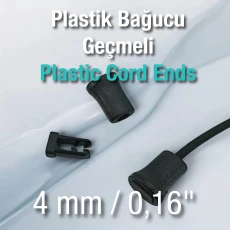
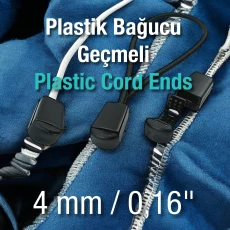
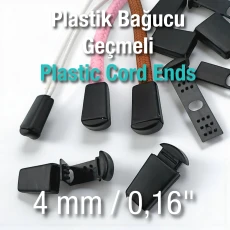
What Is a Plastic Cord End?
A plastic cord end is a fixed terminal accessory fitted to the cut end of a cord, drawstring, lace, string or compatible elastic. Depending on its construction, it may clamp the terminal section, hold it between two interlocking pieces, conceal it inside a capped body or create a clean and lightweight finish.
A plastic cord end is not a movable adjustment mechanism. Use a cord lock or drawstring stopper where the working cord length or gathering needs to be adjusted. Both component types may be used on the same cord assembly.
Which Plastic Cord End Should Be Selected?
| Application Requirement | Model to Consider | Specification to Check |
|---|
| Clamp a fine cord or string | Single-piece model with a 3 mm / 0.12 in entry | Actual cord diameter and retention after closing |
| Finish a thicker lace | Single-piece model with an entry up to 7 mm / 0.28 in | Normal and compressed lace diameter |
| Hold the cord between two plastic sections | Clamp-on interlocking cord end | Inner-piece, outer-piece, passage and closed dimensions |
| Finish a cord inside a capped body | Bell or pear-shaped capped cord end | Cord entry, lower body diameter and total body dimensions |
| Minimise component weight | Plastic cord end | Component weight, body size and proportion on the finished product |
| Coordinate the tip with the product colour | Colour-option or paintable model | Model-specific stock colours and custom-production requirements |
Plastic Cord-End Structures
Interlocking and Clamp-On Models
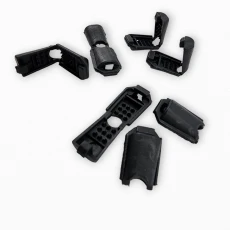
Interlocking plastic cord ends consist of an inner and an outer section. The cord, string or compatible elastic is positioned in the inner section, and the outer section is fitted over it to close the assembly.
A single cord-entry figure is not sufficient for these models. The inner-piece hole and outside dimensions, outer-piece passage and outside dimensions, and the fully closed body dimensions must be evaluated separately.
Interlocking parts do not automatically provide sufficient pull resistance on every cord. Complete a closure and pull test with the actual material.
Capped Bell and Pear-Shaped Models
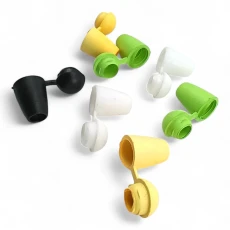
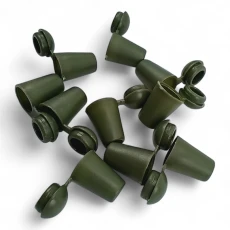
Capped bell or pear-shaped models finish the cord inside a wider decorative plastic body. Check the overall length, width and lower body diameter in addition to the cord-entry measurement.
The category includes 5 mm / 0.20 in and 5.5 mm / 0.22 in entry versions. Because the outside body is wider than the entry, the installation sequence must be planned before assembly.
Single-Piece Clamp-On Models
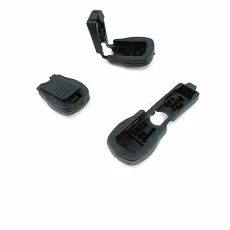
Single-piece clamp-on cord ends are positioned directly around the end of the cord or lace and closed according to the component structure. The category includes a 3 mm / 0.12 in version for finer cords and a model specified for laces up to 7 mm / 0.28 in.
Excessive closing force may crack or deform the plastic body or flatten the cord.
Verified Plastic Cord-End Dimensions
The following measurements are taken from the verified products within the category. Always use the individual product page for final approval.
| Model Structure | Verified Metric and Imperial Dimensions | Selection Note |
|---|
| Single-piece clamp-on – fine model | 3 mm / 0.12 in entry; 10.5 mm / 0.41 in total length | Test with the actual fine cord before production. |
| Single-piece clamp-on – larger model | Entry up to 7 mm / 0.28 in; 13 mm / 0.51 in total length | Filled or rigid laces may behave differently despite the nominal diameter. |
| Capped bell–pear small model | 17 × 10 mm / 0.67 × 0.39 in; 5 mm / 0.20 in entry; 8 mm / 0.31 in lower diameter | Do not confuse the entry with the outside body dimensions. |
| Capped bell–pear large model | 19 × 12 mm / 0.75 × 0.47 in; 5.5 mm / 0.22 in entry; 10.5 mm / 0.41 in lower diameter | Check the size and weight of the completed body on the finished product. |
| Interlocking aesthetic model | Inner piece 13 × 7.5 mm / 0.51 × 0.30 in; outer piece with 4 mm / 0.16 in hole and 15 × 11 mm / 0.59 × 0.43 in body; closed 15 × 11 mm / 0.59 × 0.43 in | Verify both the 4 mm / 0.16 in passage and complete engagement of the parts. |
| Interlocking small model | Inner piece with 4 mm / 0.16 in hole and 24 × 10 mm / 0.94 × 0.39 in body; outer piece with 7 × 4 mm / 0.28 × 0.16 in passage and 14 × 10 mm / 0.55 × 0.39 in body; closed 18 × 10 mm / 0.71 × 0.39 in | Do not combine all inner and outer measurements into one cord-entry value. |
| Interlocking large model | Inner piece with 4 mm / 0.16 in hole and 35 × 12 mm / 1.38 × 0.47 in body; outer piece with 9 × 4 mm / 0.35 × 0.16 in passage and 18 × 12 mm / 0.71 × 0.47 in body; closed 13 × 21 mm / 0.51 × 0.83 in | Check both cord compatibility and the scale of the closed body. |
How to Measure Plastic Cord-End Compatibility
Do not rely only on the nominal size stated by the cord supplier. Measure several points with a caliper and record a lightly compressed measurement for soft, filled or elastic materials.
| Feature to Check | Why It Matters | Application Note |
|---|
| Outside cord diameter | Determines whether the cord can enter the component. | Measure several points without flattening the cord. |
| Compressed diameter | Shows how much a soft cord narrows during closing. | Compare it with the normal measurement. |
| Cord surface | Smooth or rigid surfaces may change clamping performance. | Pull the cord in its actual operating direction. |
| Finished terminal section | Heat sealing, knots or thickened sections may affect insertion. | Plan the assembly before completing the cord end. |
| Closed body dimensions | Determine visual scale and whether the fitted part can pass through other components. | Compare with stopper and eyelet openings. |
| Complete part engagement | Incomplete closure may reduce retention on interlocking models. | Check that all sections are fully seated. |
Interlocking vs Single-Piece Clamp-On Models
| Feature | Interlocking Model | Single-Piece Clamp-On Model |
|---|
| Number of pieces | Uses separate inner and outer sections. | Uses one plastic body. |
| Assembly | The cord is positioned in the inner section and the outer section closes over it. | The body is closed directly around the cord end. |
| Measurements | Inner piece, outer piece, passage and closed dimensions must be checked. | Entry, total length and closing structure must be checked. |
| Incorrect assembly risk | Parts may not fully engage or the cord may be incorrectly positioned. | Excess force may crack the body or crush the cord. |
Capped vs Clamp-On Plastic Cord Ends
Capped bell–pear models finish the cord inside a wider decorative body. Single-piece clamp-on models are more compact and close directly around the terminal section.
For a capped model, check cord entry, total length, width and lower diameter. For a clamp-on model, check the entry, total body length and required closing force.
Colour and Custom-Production Options
Depending on the model, category products may be offered in black, white, navy, red, yellow, pink, blue and other colours. Some models may be paintable or suitable for custom-colour production.
Not every colour is continuously stocked for every model. Minimum quantity, colour approval, sampling and production conditions must be verified for custom colours, logos or dimensions.
Plastic and Metal Cord Ends Compared
| Feature | Plastic Cord End | Metal Cord End |
|---|
| Weight | Provides a lighter terminal component. | May create a heavier and more noticeable hardware detail. |
| Appearance | May be coloured, plain, matt, glossy or paintable. | May use plated, painted and decorative metal surfaces. |
| Assembly structures | Interlocking, capped and clamp-on structures are available. | Crimp-on, knot-retained, sew-on, bond-on and pass-through structures may be available. |
| Primary selection reason | Low weight, colour matching and practical assembly | Metal appearance and coordination with other hardware |
For metal alternatives, review the metal cord ends category.
Real-World Applications
- Hoodie and sweatshirt drawstring ends
- Tracksuit, shorts and sportswear cords
- Bag, backpack, pouch and wallet cords
- Shoe and lightweight boot laces
- Lingerie and lightweight textile products
- Sports equipment and promotional-item cords
- Compatible strings and round-elastic ends
- Textile and accessory designs requiring colour coordination
Not every plastic cord end is suitable for every application. Final selection must be based on the verified dimensions, fitting structure, colour and pack information on the individual product page.
Recommended Assembly Sequence
- Measure the normal and lightly compressed cord diameter.
- Thread any required cord lock onto the cord before fitting the terminal component.
- Pass the cord through the garment, bag or footwear channel or eyelet.
- Set the final cord length and terminal allowance.
- Complete any required cutting, heat-sealing or knotting process.
- Position the cord correctly in the entry or inner section.
- Clamp the component, close the cap or fit the outer section over the inner section.
- Confirm full closure and test that the cord does not pull out.
Incorrect Selection and Assembly Warnings
- A plastic cord end and a cord lock do not perform the same function.
- An opening that is too small may prevent insertion or damage the cord surface.
- An opening that is too large may reduce retention.
- Check inner and outer component dimensions separately on interlocking models.
- Incomplete engagement may allow the parts to separate during use.
- Excessive closing force may crack the plastic body or crush the cord.
- Measure the compressed diameter of soft and elastic cords.
- A fitted cord end may not pass through a stopper channel or eyelet.
- Plastic appearance alone does not confirm wash, temperature or outdoor suitability.
- Small-part and detachment risks must be assessed separately for children’s products.
- Complete a sample installation with the actual cord before wholesale ordering or mass production.
Related Categories
Frequently Asked Questions About Plastic Cord Ends
What is a plastic cord end and what does it do?
A plastic cord end is a lightweight fixed terminal accessory used to clamp, cover or neatly finish the cut end of a cord, drawstring, lace, string or compatible elastic.
How do I select the correct plastic cord-end size?
Measure the outside diameter and, for soft material, the lightly compressed diameter. Compare these measurements with the verified entry, inner-piece hole or internal opening.
How is an interlocking plastic cord end fitted?
The cord is positioned in the inner section and the outer section is fitted over it. Confirm that the pieces are fully engaged and that the cord does not pull out under tension.
How is a capped plastic cord end fitted?
The cord is passed through the verified entry or positioned inside the body. The exact closure and retention method must be checked according to the individual product structure.
Does a single-piece clamp-on cord end require a press?
The required tool depends on the model and production quantity. A controlled hand tool may be sufficient, but excessive force can crack the plastic body, so sample testing is required.
Can a plastic cord end be used with round elastic?
It may be used when the entry and clamping structure are compatible. Because elastic changes diameter under compression and tension, test it with the actual material.
Should the cord lock or plastic cord end be installed first?
If the completed cord end is larger than the cord-lock channel, thread the cord lock first and fit the plastic cord end after completing the cord route.
Why do interlocking models have several measurements?
They use separate inner and outer pieces. The inner hole, outer passage, component body dimensions and fully closed size perform different functions and must be checked separately.
Are plastic cord ends machine washable?
Wash suitability cannot be determined from the plastic appearance alone. The polymer, colour treatment, assembly structure, wash temperature and detergent conditions must be evaluated.
Can plastic cord ends be produced in custom colours?
Some models may be suitable for custom colours or painting. Minimum quantity, colour approval, sampling and production conditions must be verified for each model.
Is sample testing necessary before wholesale production?
Yes. A sample confirms entry compatibility, complete closure, clamping performance, colour, body size and appearance on the finished product.
Last updated: 21 July 2026
Business and brand: E-Düğme – Istanbul, Türkiye
Technical verification note: Refer to the individual product page for exact metric and imperial entry dimensions, inner and outer component sizes, closed dimensions, colour, pack quantity and fitting method.