What Are Elastic Bands and Waistbands?
Elastic bands and waistbands are flexible textile components used to provide stretch, recovery, gathering, support, tension or adjustable fit. Depending on their construction, they may be sewn directly to fabric, enclosed inside a casing, threaded through a narrow channel or combined with adjustment accessories.
Different elastic structures should not be treated as interchangeable. A flat woven elastic used inside a trouser waistband performs a different task from a round elastic cord used in a hood channel or a narrow bra strap elastic combined with lingerie rings and sliders.
This category is organised into three principal groups:
Which Type of Elastic Should Be Selected?
| Application |
Elastic Type to Consider |
Main Compatibility Check |
| Trousers, skirts, shorts or pyjama waistbands |
Woven elastic band |
Band width, casing height, fabric weight and sewing structure |
| Tracksuits, leggings and sportswear waistbands |
Woven elastic band |
Required support, finished waistband height and sample stretch test |
| Hoods, bag openings and gathered hems |
Round braided elastic cord |
Cord diameter, channel size and cord-lock compatibility |
| Masks, lightweight gathering and narrow channels |
Fine round elastic cord |
Diameter, skin contact, required tension and attachment method |
| Bra, bralette or bustier straps |
Bra strap elastic |
Elastic width and the internal width of the ring, slider and hook |
| Camisoles, nightwear and narrow adjustable straps |
Bra strap elastic or another verified narrow elastic |
Width, surface feel, strap hardware and sewing method |
| Adjustable elastic passing through an eyelet |
Round elastic cord |
Normal diameter, compressed diameter and eyelet opening |
| Elastic used with a cord lock and cord end |
Round elastic cord |
Cord-lock passage, cord-end entry and actual holding performance |
Woven Elastic Bands
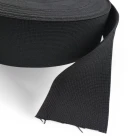
Woven elastic is a flat elastic band intended for applications where the material needs to sit across a wider area. It may be used inside waistband casings or sewn into garment sections such as waists, cuffs and leg openings, depending on the individual product and sewing design.
Woven elastic should be selected according to the internal height of the fabric casing, the weight and structure of the fabric, the required support and the way the elastic will be secured. A band that is too wide may fold or become difficult to insert, while a band that is too narrow may move, twist or fail to fill the intended waistband area.
Common Woven-Elastic Width Groups
| Elastic Width |
General Application Logic |
Selection Check |
| 15 mm / 0.59 in |
Narrow garment casings, light sewing projects and compact elastic areas |
Check the internal casing height and whether the band remains flat. |
| 25–30 mm / 0.98–1.18 in |
Trousers, skirts, shorts, pyjamas and medium-width waistband casings |
Compare the elastic width with the completed fabric channel. |
| 35–40 mm / 1.38–1.57 in |
Tracksuits, leggings, sportswear and more visible waistband structures |
Check support, fabric weight and comfort after sewing. |
| 45–50 mm / 1.77–1.97 in |
Wide waistbands, supportive garment sections and selected shapewear applications |
Complete a sample to check folding, rolling and pressure distribution. |
| 55–60 mm / 2.17–2.36 in |
Extra-wide waistbands and larger textile casings |
Check the finished waistband height, seam allowance and garment proportions. |
These width groups are general selection references and do not guarantee suitability for every garment. Elastic construction, fabric weight, seam structure and required tension must be evaluated together.
Round Braided Elastic Cord
Round braided elastic cord has a circular or cord-like cross-section. It may be threaded through narrow textile channels, eyelets, cord locks and cord ends in hoods, bags, masks, sportswear, childrenswear and gathered textile products.
The most important dimensional value for round elastic is its actual diameter. The diameter must be compatible with every part of the route, including the fabric channel, eyelet, cord lock and terminal cord end.
Round Elastic Diameter Guide
| Elastic Diameter |
General Application Logic |
Compatibility Check |
| 1.5 mm / 0.06 in |
Fine gathering, lightweight textile work and narrow passages |
Check comfort, required tension and attachment security. |
| 2 mm / 0.08 in |
Masks, lightweight gathering, small accessories and narrow channels |
Compare the cord with the channel and attachment point. |
| 2.5–3 mm / 0.10–0.12 in |
Hoods, bag openings, sportswear and medium-size adjustment systems |
Check cord-lock, eyelet and cord-end compatibility. |
| 4 mm / 0.16 in |
More visible gathering, wider channels and selected bag or garment applications |
Confirm that the elastic moves freely and locks securely. |
Nominal diameter alone does not guarantee compatibility. Braiding density, softness, filling, surface friction and compressibility may change how the elastic passes through and performs inside an accessory.
Bra Strap Elastics
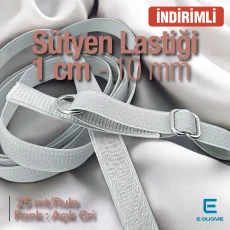
Bra strap elastic is a narrow flat elastic intended for lingerie straps and similar adjustable textile systems. It may be used in bras, bralettes, bustiers, camisoles, nightwear, swimwear and other products requiring a narrow elastic strap.
The current category includes 10 mm / 0.39 in bra elastics. A 10 mm / 0.39 in elastic should be combined with rings, sliders, hooks or other strap components that provide a compatible internal passage.
Colour should also be evaluated with the main fabric and visible lingerie hardware. Depending on the product, black, white, beige, grey, navy, pink, burgundy, ecru or other colour options may be available.
Do not assume that every 10 mm / 0.39 in component will fit identically. The actual elastic thickness, edge construction and the verified internal opening of the hardware should be tested before production.
Woven Elastic, Round Elastic and Bra Elastic Compared
| Feature |
Woven Elastic |
Round Elastic Cord |
Bra Strap Elastic |
| Cross-section |
Flat and relatively wide |
Round or cord-like |
Flat and narrow |
| Common application |
Waistbands, garment casings and wider elastic areas |
Hoods, gathering, masks, bags and narrow channels |
Lingerie straps and narrow adjustable strap systems |
| Main measurement |
Width |
Diameter |
Strap width |
| Accessory compatibility |
Fabric casing and sewing structure |
Eyelet, cord lock, cord end and fabric channel |
Ring, slider, hook and strap connector |
| Main selection risk |
Twisting, folding or unsuitable waistband height |
Poor passage, slipping or excessive compression |
Incompatible hardware or unsuitable strap feel |
How to Measure Elastic Correctly
| Measurement |
Why It Matters |
Recommended Check |
| Flat elastic width |
Determines compatibility with the fabric casing and garment design. |
Measure the relaxed elastic without stretching it. |
| Round elastic diameter |
Determines whether the elastic passes through channels and accessories. |
Measure several points without flattening the elastic. |
| Lightly compressed diameter |
Shows how a soft round elastic behaves inside a cord lock or eyelet. |
Compare it with the relaxed diameter. |
| Fabric-casing height |
Determines whether a flat elastic can remain smooth inside the channel. |
Measure the completed internal opening after seam allowances. |
| Hardware internal width |
Determines compatibility with bra elastic and strap components. |
Check the actual internal passage rather than outside hardware width. |
| Roll length |
Determines whether the quantity is suitable for sampling or production. |
Calculate total consumption and include cutting and testing allowance. |
Roll Length and Production Planning
Elastic products may be offered in different roll or pack lengths depending on the item. Examples within the category include 5 m / 16.4 ft, 10 m / 32.8 ft, 25 m / 82.0 ft and 100 m / 328 ft formats.
Roll length should be selected according to:
- The number of finished products
- Elastic consumption per garment
- Cutting and joining allowance
- Sample and quality-control requirements
- Possible colour or batch separation
- Whether a continuous length is required
Do not calculate production quantity from the stated roll length alone. Allow for cutting loss, sample sewing, damaged sections, joins and production testing.
Elastic, Cord and Cord Ends Are Different Components
| Component |
Main Function |
Selection Priority |
| Round elastic cord |
Provides stretch and recovery. |
Diameter, elasticity and accessory compatibility |
| Non-elastic cord or drawstring |
Provides tying, adjustment or decorative routing. |
Diameter, material, flexibility and intended load |
| Cord lock |
Adjusts and helps hold the cord or compatible elastic. |
Passage size, mechanism and actual holding test |
| Cord end |
Finishes the cut terminal section. |
Internal entry, fitting structure and finished outside size |
| Eyelet |
Creates a reinforced passage through the textile. |
Finished internal opening, material thickness and setting system |
For round elastic systems, review the relevant cord locks and drawstring stoppers before production. The normal and compressed elastic diameter should be compatible with the passage and the mechanism should be tested under actual tension.
Real-World Applications
- Trousers, skirts, shorts and pyjama waistbands
- Tracksuit, leggings and sportswear waistbands
- Garment cuffs, leg openings and fabric casings
- Hoodie, jacket and coat adjustment channels
- Bag, pouch and drawstring-sack openings
- Masks and lightweight gathered textile products
- Bras, bralettes, bustiers and camisole straps
- Nightwear, lingerie and compatible swimwear applications
- Childrenswear and selected adjustable garment systems
- Craft, repair and small-scale sewing projects
Not every elastic is suitable for every application. Skin contact, repeated stretching, washing, heat, chemicals, outdoor exposure and the required recovery must be verified for the individual product.
Recommended Selection and Sewing Process
- Define whether the elastic will be used in a waistband, casing, gathered channel or adjustable strap.
- Select woven, round braided or bra strap elastic according to the application.
- Measure the fabric casing, accessory passage or strap hardware.
- Check the relaxed width or diameter of the elastic.
- For round elastic, also check the lightly compressed diameter.
- Calculate the required finished length and production allowance.
- Prepare a sample using the actual fabric, thread, hardware and sewing method.
- Test stretch, recovery, comfort, twisting, slipping and appearance.
- Approve the sample before full production or wholesale ordering.
Incorrect Selection and Application Warnings
- Do not use round elastic as a substitute for a wide waistband without testing the complete garment structure.
- Do not select woven elastic without measuring the finished internal height of the casing.
- Do not combine bra elastic with rings, sliders or hooks that have an incompatible internal width.
- A round elastic that is too thick may not pass through an eyelet, cord lock or cord end.
- A round elastic that is too thin may slip inside a cord-lock mechanism.
- A wide elastic may fold or roll if the fabric channel is unsuitable.
- A narrow elastic may twist or move inside an oversized waistband casing.
- Colour appearance may vary between screens, fabrics and production batches.
- Material composition should not be assumed from appearance alone.
- Stretch percentage and recovery should be verified on the individual product or by sample testing.
- Wash, heat, chlorine, saltwater or chemical resistance must not be assumed for the whole category.
- Complete a sample sewing and performance test before mass production.
Related E-Düğme Categories
Frequently Asked Questions About Elastic Bands
What is the difference between waistband elastic and woven elastic?
Waistband elastic is a general application term. Woven elastic is one type of flat elastic that may be used in waistbands, garment casings and other wide elastic sections.
Which elastic should be used for trousers or tracksuit waistbands?
Flat woven elastic is generally considered for trousers, skirts, shorts, tracksuits and similar waistband casings. The width must be matched to the completed casing and fabric structure.
What is the difference between round elastic and braided elastic?
Round elastic describes the finished circular form. Braided elastic describes a production structure. Check the product shape, diameter, braid and stated application rather than treating every braided elastic as identical.
Where is round elastic cord used?
Round elastic cord may be used in hoods, masks, bag openings, gathered hems, narrow textile channels and adjustable systems using compatible cord locks, cord ends or eyelets.
How do I select the correct round elastic diameter?
Measure the relaxed and lightly compressed diameter and compare both values with the fabric channel, eyelet, cord-lock passage and cord-end entry.
Which hardware is compatible with 10 mm bra elastic?
A 10 mm / 0.39 in bra elastic should be used with rings, sliders, hooks and strap components that have a verified compatible internal passage.
Can round elastic be used with a cord lock?
Yes, when the relaxed and compressed diameter is compatible with the cord-lock passage and the mechanism holds the elastic securely without damaging it.
How much elastic is required for production?
Calculate the finished elastic length per item, multiply it by the production quantity and add an allowance for cutting, joining, samples and quality-control testing.
Does elastic width determine its strength?
No. Width alone does not determine support, stretch or recovery. Construction, material, thickness, stitch structure and the finished application also affect performance.
Can all elastics be machine washed?
Wash suitability cannot be applied to the whole category. Check the individual elastic composition, colour treatment, sewing method and the care conditions of the finished textile product.
Should elastic be tested before mass production?
Yes. A sample test helps verify width or diameter, casing compatibility, stretch, recovery, comfort, hardware fit, colour and appearance on the finished product.
Last updated: 30 July 2026
Business and brand: E-Düğme – Istanbul, Türkiye
Technical verification note: Refer to the individual product page for exact metric and imperial dimensions, material composition, colour, roll length, pack quantity, stretch characteristics and intended application.

.jpg-40x40.webp "Magnetic Snaps Buttons")

.jpg-40x40.webp "Prong Snap Fasteners for Baby Clothes")


.jpg-40x40.webp "Curved Snaps Buttons")


.jpg-40x40.webp "Snap Fasteners Half Dome type")
-no5-k0010%20(3).jpg-40x40.webp "Eyetlets")


-K0014.png-40x40.webp "Steel Eyelets and Iron Metal Grommets")

.jpg-40x40.webp "Flat Brass Eyelets and Grommets")

.jpg-40x40.webp "Aluminum Eyelets and Grommets")


.jpg-40x40.webp "Galvanized Eyelets and Grommets")


.jpg-40x40.webp "Hole Cutter Tools and Punching Dies")

.jpg-40x40.webp "Grommet Punching Dies")


.jpg-40x40.webp "Pearls Types")


.jpg-40x40.webp "Rivets")


.jpg-40x40.webp "Water-Repellent Jacket Zippers")


.jpg-40x40.webp "Tires")

.jpg-40x40.webp "Round Braided Elastic Cord")


.png-40x40.webp "Enameled Buttons")


.png-40x40.webp "Two Hole Sewing Buttons")


.jpg-40x40.webp "Carabiner Clips, Snap Hooks and Bag Hooks")


-PhotoRoom.png-40x40.webp "Spring Rings, Key Rings and Snap Clamps")


.png-40x40.webp "Hook and Eye Closures Sew-On")


.png-40x40.webp "Bag Making Kits")

.png-40x40.webp "Continuous Zipper Sets")


.jpg-40x40.webp "Bra Underwires")




-no5-k0010%20(3).jpg-590x590.webp "Eyelets and Grommets")
.jpg-590x590.webp "Rivets")
.jpeg-100x100.webp "Bra Elastic and Bra Clasps 3-Piece Set - Pink 1cm - 0,39\" Elastic 100m/Roll SUT0010Pink")
.jpeg-100x100.webp "Bra Elastic and Bra Clasps 3-Piece Set - Beige 1 cm - 0,39\" Elastic 100 mt/Roll SUT0010Biege")
.jpg-100x100.webp "1 cm - 0,39\" Ring - Chain Link Ring 5000 pcs/ Pack A000H1")
.webp-100x100.webp "1 cm / 0.39 in Oval Eyelet Setting Die for Oval Grommet Installation KLPK0010OVLNO2")
.webp-100x100.webp "1–15 mm / 0.039–0.591 in Padova Hole Cutter Collection with 18 Cutter Sets and Long-Handle Striking Tool PDVSET0015EL")
.webp-100x100.webp "1.5 cm / 0.59 in Oval Eyelet Setting Die for Oval Grommet Installation KLPK0015OVLNO3")
.jpeg-100x100.webp "10 mm / 0.39 in Gold Zamak Bra Strap Slider and Ring Set, 500 Pairs PBT0006PROMO")
.webp-100x100.webp "10 mm / 0.39 in Inner Diameter Antique Brass-Tone Stainless Metal Eyelet Capsule, 250 pcs/Pack ER0024PPKAS")
.webp-100x100.webp "10 mm / 0.39 in Inner Diameter Antique Silver-Tone Stainless Metal Eyelet Capsule, 250 pcs/Pack ER0024PPKKO")

.jpg-136x136.webp "Round Braided Elastic Cord")
.jpeg-230x230.webp "Bra Elastic and Bra Clasps 3-Piece Set - Beige 1 cm - 0,39\" Elastic 100 mt/Roll SUT0010Biege")
.jpeg-230x230.webp "Bra Elastic and Bra Clasps 3-Piece Set - Pink 1cm - 0,39\" Elastic 100m/Roll SUT0010Pink")
.jpeg-230x230.webp "Bra Elastic 10 mm - 0,39\" - 100 mt/Roll SUT0010")