20 mm / 0.79 in Sheet Steel File Eyelet MT00020S: complete guide for folders, shoe boxes and packaging
MT00020S is a sheet-steel file eyelet with a nominal 20 mm / 0.79 in inner diameter. It is intended for files and binders, shoe boxes, cardboard and paperboard packaging, archive systems, sample cards, presentation folders, promotional boxes and similar industrial paperboard applications where a wide, neat opening is required. The product is sold in 1,000-piece packs.
1. Verified product information
- Model: MT00020S
- Product type: file / shoe-box eyelet
- Nominal inner diameter: 20 mm / 0.79 in
- Material: sheet steel
- Sales unit: 1,000 pieces/pack
- Minimum order: 1 pack
- Application: dedicated compatible setting die and suitable press/machine
Older Turkish and English records contain conflicting outer-diameter and height values. Those unverified dimensions are intentionally not presented as confirmed specifications in this updated content.
2. What is a file eyelet?
A file eyelet reinforces and finishes a hole in cardboard, paperboard and similar rigid sheet materials. An unreinforced hole can crush, widen or tear over time. The metal eyelet creates a defined edge that improves durability and appearance while allowing string, cord, hanging components or ventilation openings to pass through the material more cleanly.
3. When is a 20 mm opening useful?
A 20 mm opening is substantially larger than common garment eyelets and suits shoe boxes, binders, sample cards, archive boxes and packaging designs that need a broader functional aperture. The correct choice depends on the component passing through the opening, board thickness, distance from the edge and whether the hole is decorative, structural or used for ventilation.
4. Use in shoe boxes
In shoe-box production, the eyelet can be used for ventilation, carrying, hanging or decorative holes. The metal frame gives the cut opening a cleaner finished appearance, especially on premium boxes with laminated or wrapped paperboard. Press pressure must be controlled: too much pressure can crush the board, while insufficient pressure may leave the eyelet loose.
5. Use in files and binders
Files and binders may use eyelets for hanging, tying, cord passage or mechanical attachment. Rigid board can show fiber lift or layer separation around a punched hole. The eyelet helps organize this area and provides a metal edge. In production, aligned hole centers and a stable press setting improve consistency across a batch.
6. Why board thickness matters
Material thickness changes the way the eyelet sets. Thin board can be crushed by excessive force, while thicker paperboard may require more controlled forming. If the product is laminated, coated or wrapped, the surface layers also affect the finished result. Always test the actual production construction rather than relying on a generic setup.
7. Preparing the opening
Hole preparation is one of the most important steps. An off-center hole makes the finished eyelet look misaligned; an oversized hole can create looseness; a rough cut can leave exposed fibers around the metal edge. The cutting or punching tool should match the actual application. Because no verified dedicated punching-die product code is recorded for MT00020S, no unverified die is linked here.
8. Why the setting die must match the product
File eyelets can have different geometry from textile eyelets. Similar inner diameter does not guarantee die compatibility. The setting die must support the visible face and form the rear section without crushing the board. For MT00020S, confirm the dedicated setting die using the exact model code before production.
9. Press and machine selection
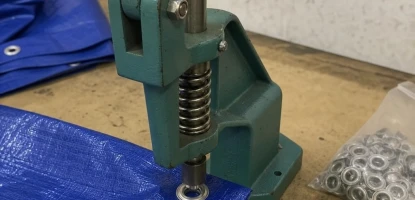
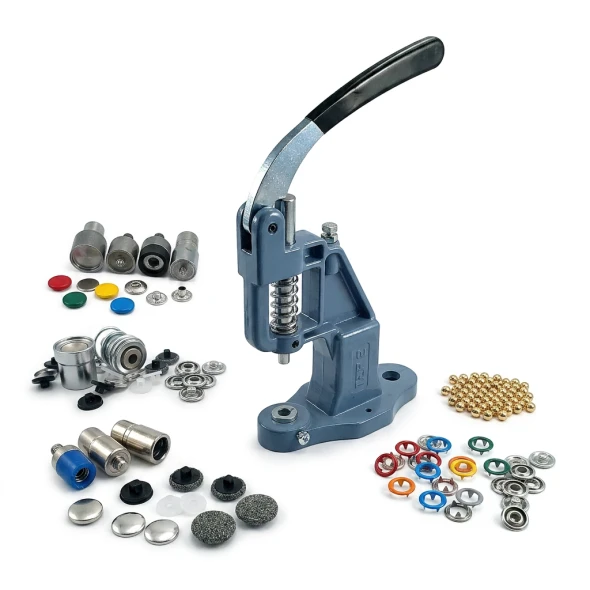
A hand press may be sufficient for sampling and lower production volumes, while pneumatic or motorized systems can be useful at higher volumes. When a compatible die connection is available, the M0099 hand press can be considered for controlled manual production. The key requirement is repeatable pressure with correct tooling, not simply maximum force.
10. Recommended application sequence
- Measure and mark the eyelet position.
- Check edge distance and alignment.
- Measure total board thickness.
- Create a clean opening with appropriate tooling.
- Place the eyelet squarely and centrally.
- Install the dedicated MT00020S-compatible setting die.
- Run the first sample with controlled pressure.
- Check for rotation, looseness and board crushing.
- Fix the setting only after the sample is correct.
- Carry out periodic quality checks during production.
11. Common mistakes
- Confusing the 20 mm inner diameter with outer diameter.
- Using a die made for a different eyelet geometry.
- Punching an oversized opening.
- Misaligning hole centers across a box or folder.
- Crushing the board with excessive press force.
- Leaving the eyelet loose with insufficient force.
- Ignoring cracking on laminated surfaces.
- Starting serial production without a sample.
12. Choosing between 20 mm and 23 mm
The difference between 20 mm and 23 mm may appear small, but a 3 mm change in finished opening can matter for cord passage, ventilation and visual scale. If a larger opening is needed, compare this product with the 23 mm MT00023S file eyelet. Choose according to the real functional opening requirement rather than appearance alone.
13. Use on sample cards and catalogs
Textile, leather and material sample cards often use an eyelet as a hanging or binding point. The metal edge can reduce wear where a hook or string passes through the board. Heavier samples may require more edge distance or local reinforcement around the hole to prevent the card from tearing.
14. Promotional and display applications
Retail displays, hanging cards and promotional boards can use a 20 mm eyelet as a visible metal detail. Finish and plating can coordinate with the packaging design. Keeping the setting die clean helps prevent scratches and pressure marks on the visible metal surface.
15. Ventilation applications
Some packaging uses an eyelet as a finished ventilation opening. In this case, total open area, number of holes and the packaged product's actual ventilation requirement must be considered. The eyelet finishes the opening mechanically but does not replace product-specific ventilation calculations.
16. Pack and stock planning
MT00020S is sold in 1,000-piece packs. Purchasing should account for setup samples, quality-control pieces and normal production loss in addition to the net production requirement. Where finish consistency matters, obtaining enough units from the same batch can help maintain a uniform appearance.
17. Production quality control
The finished eyelet should sit flat, should not rotate freely and should not excessively crush the board. There should be no tearing, delamination, coating cracks or obvious scratches around the opening. Periodic samples should be taken during production to confirm that press settings remain stable.
18. Operator checklist
- Is the model MT00020S?
- Is the required finished opening 20 mm / 0.79 in?
- Has board thickness been checked?
- Is the hole position correctly marked?
- Is the cut clean?
- Has the setting die been verified for this model?
- Has press pressure been tested?
- Does the sample rotate or feel loose?
- Is the board crushed?
- Are periodic production checks scheduled?
19. Purchasing criteria
Check the model code, nominal inner diameter, sales unit and intended application together. Buying by “20 mm” alone can lead to a different eyelet family and incompatible tooling. If you already own dies, verify compatibility with MT00020S before ordering. If tooling is not available, request a dedicated compatible die using the exact model code.
20. Who should use MT00020S?
This product is suitable for file and binder manufacturers, shoe-box producers, paperboard packaging companies, textile and leather firms preparing sample cards, promotional-display manufacturers and workshops that regularly use wide metal eyelets. First-time users should evaluate the complete eyelet-die-press system rather than the eyelet alone.
21. Search intent and product terminology
Customers typically reach this product through terms such as “20 mm eyelet,” “file eyelet,” “shoe box eyelet,” “binder eyelet,” “box eyelet,” “metal eyelet” and “1000-piece eyelet pack.” Explaining these use cases naturally helps users understand whether MT00020S is the correct product and helps search engines interpret the page more accurately.
Frequently Asked Questions
What is the nominal inner diameter?
20 mm / 0.79 in.
How many pieces are in one pack?
1,000 pieces.
Can it be used on shoe boxes?
Yes, with suitable board construction and verified tooling.
Is it suitable for files and binders?
Yes. It belongs to the file/binder eyelet family.
Which setting die should be used?
A dedicated die compatible with MT00020S should be used. No verified product code is currently recorded.
Can it be used with M0099?
Yes, if a compatible die connection for MT00020S is available.
What is the outer diameter?
Older records conflict, so no unverified outer diameter is stated.
How is it different from the 23 mm model?
MT00023S provides a 3 mm larger nominal inner opening.











-K0011.jpg-185x185.webp "3.5 mm / 0.14 in Sheet Steel Eyelet – 250-Piece Pack K0011")





 Not sure about the size?Ask before you order — we'll help you pick the right size and matching setting tool.We're online · Mon–Fri 09:00–18:00, Sat 09:00–13:00 (GMT+3)Ask on WhatsApp☎ +90 530 520 40 09Get a bulk quote →★ 4.6 customer rating · 2,100+ orders · office & store in Istanbul