
.jpg-40x40.webp "Magnetic Snaps Buttons")

.jpg-40x40.webp "Prong Snap Fasteners for Baby Clothes")


.jpg-40x40.webp "Curved Snaps Buttons")


.jpg-40x40.webp "Snap Fasteners Half Dome type")
-no5-k0010%20(3).jpg-40x40.webp "Eyetlets")


-K0014.png-40x40.webp "Steel Eyelets and Iron Metal Grommets")

.jpg-40x40.webp "Flat Brass Eyelets and Grommets")

.jpg-40x40.webp "Aluminum Eyelets and Grommets")


.jpg-40x40.webp "Galvanized Eyelets and Grommets")


.jpg-40x40.webp "Grommet Punching Dies")
.jpg-40x40.webp "Hole Cutter Tools and Punching Dies")


.jpg-40x40.webp "Pearls Types")


.jpg-40x40.webp "Rivets")


.jpg-40x40.webp "Water-Repellent Jacket Zippers")


.jpg-40x40.webp "Tires")

.jpg-40x40.webp "Round Braided Elastic Cord")


.png-40x40.webp "Enameled Buttons")


.png-40x40.webp "Two Hole Sewing Buttons")


.jpg-40x40.webp "Carabiner Clips, Snap Hooks and Bag Hooks")


-PhotoRoom.png-40x40.webp "Spring Rings, Key Rings and Snap Clamps")


.png-40x40.webp "Hook and Eye Closures Sew-On")


.png-40x40.webp "Bag Making Kits")

.png-40x40.webp "Continuous Zipper Sets")


.jpg-40x40.webp "Bra Underwires")




-no5-k0010%20(3).jpg-590x590.webp "Eyelets and Grommets")
.jpg-590x590.webp "Rivets")
.jpg-1140x300w.webp "Hook and Eye Closures: Types, Sizes, Uses and Selection Guide")
What is a hook-and-eye closure? It is a garment fastening system in which a hook engages a matching eye, loop or receiving piece. Depending on construction, this hardware can help close jackets, dresses, skirts and other apparel. The correct choice is not simply the smallest or most decorative option: a buyer should compare the fastening action, attachment area, garment fabric and mating component before specifying a model.
Types of hook-and-eye and frog fastenings
Sew-on hook-and-eye clasps
Sew-on hardware is secured through a designed attachment area. The E 1858 metal garment hook is one example to inspect for profile and sewing clearance. The hook engages the opposing piece when the garment is closed. These fasteners can be considered for jackets, dresses and textile accessories where a small closure is needed. The sewing point and the direction of tension matter just as much as the visible outline.
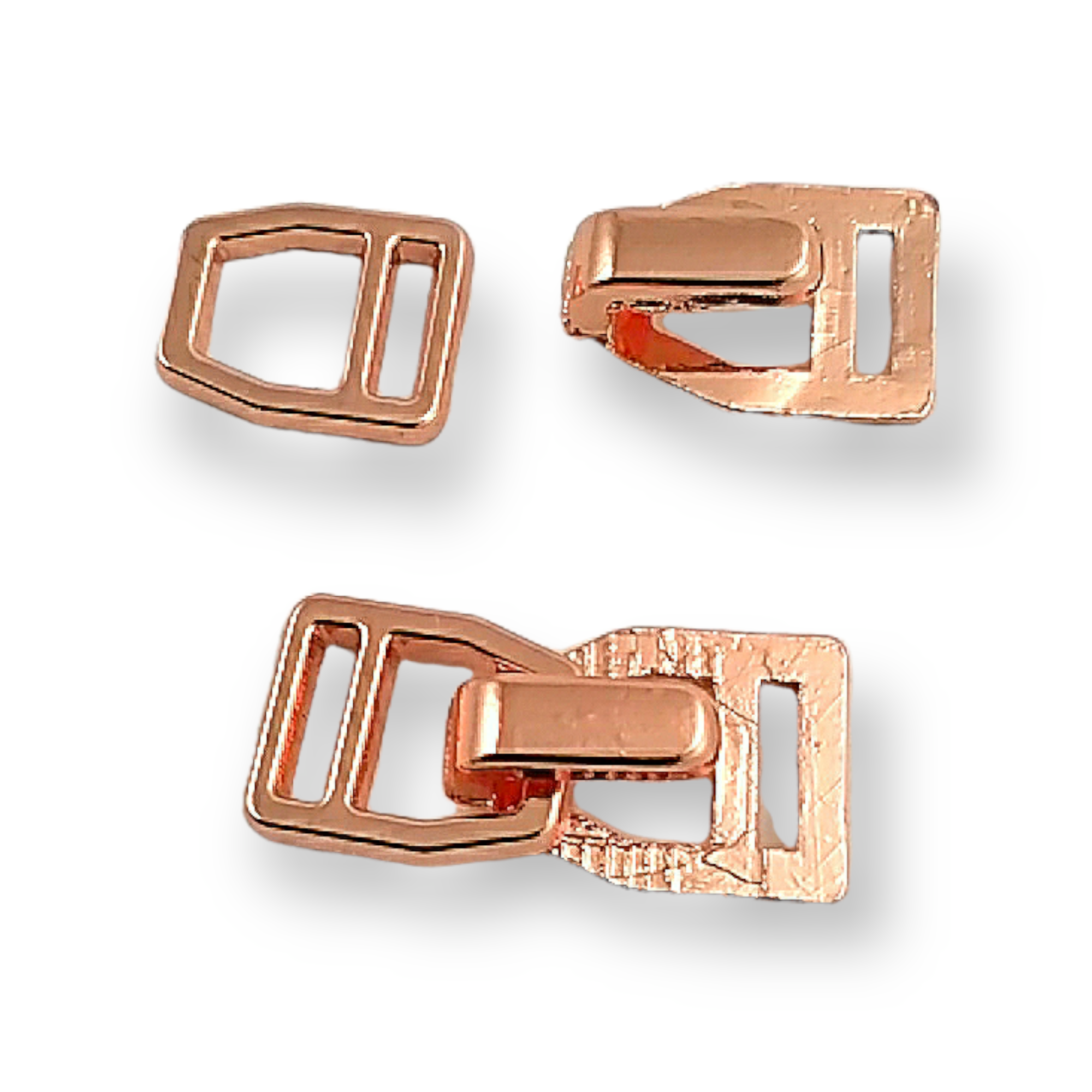
Metal garment hooks with different sewing widths
A name such as 14.5 mm should never be interpreted as a universal outside dimension. In the E 1763 reference, the 14.5 mm specification is associated with the sewing section. Buyers should also review the closed length, hook clearance, compatible receiver and available mounting area before approval.
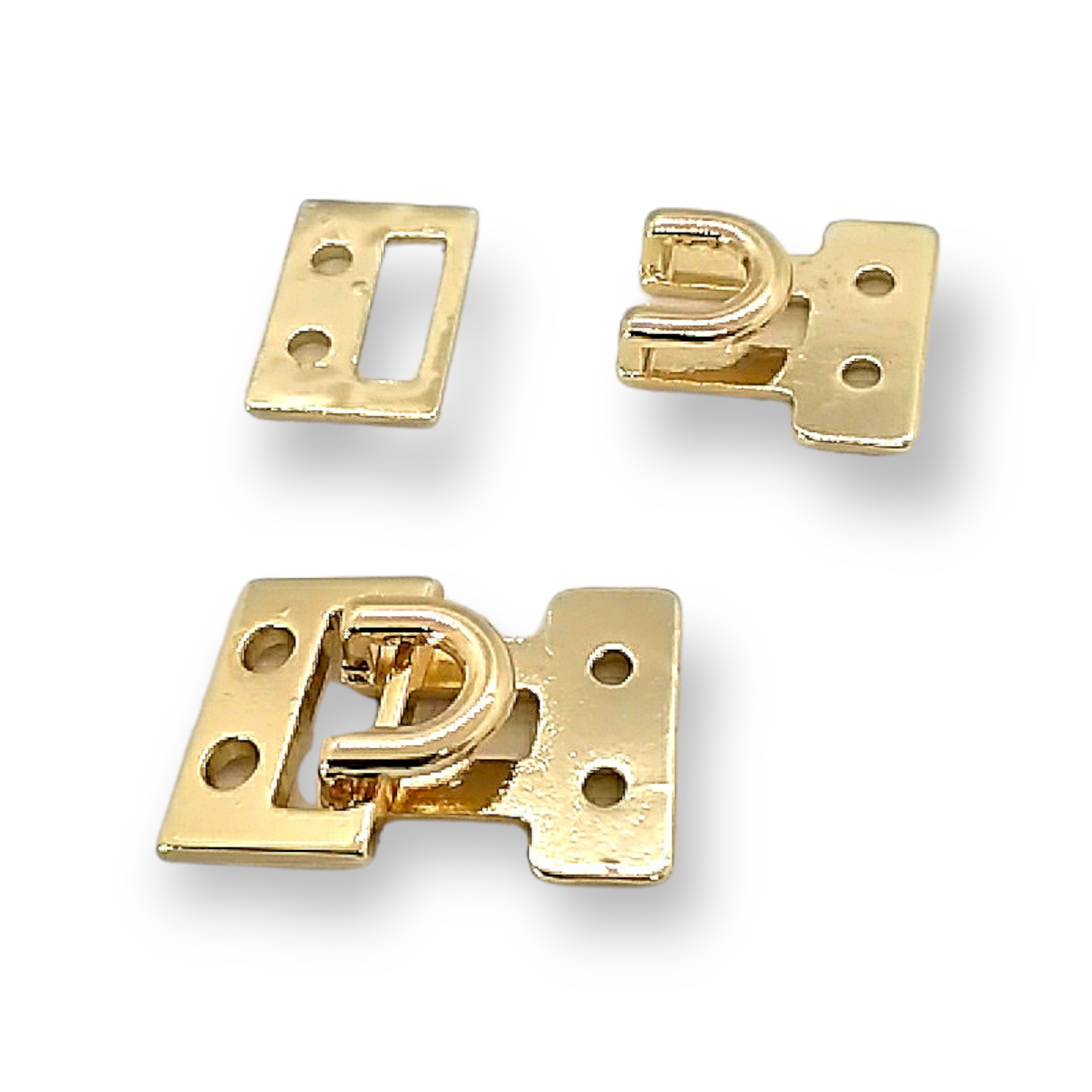
Decorative clasps for outerwear and fashion design
Decorative jacket and coat fasteners can be intentionally visible. They may use patterned metalwork, stone-like details or ornamental forms. Select these as design-and-function components: an elaborate external profile does not establish that a clasp will substitute for a small concealed hook.
Hook-and-bar closures for trousers and skirts
Tailored waistband closures are sometimes grouped with hooks and eyes in search results, but constructions vary. A hook-and-bar waistband assembly used beside a zipper has different fit and installation considerations from a sew-on decorative frog fastening. Confirm the actual attachment method rather than assuming all products labeled “hooks” fit the same application.
How to select the right size
Dimensions such as 6 mm (about 0.24 in), 7.5 mm (about 0.30 in) and 14.5 mm (about 0.57 in) appear in garment-hook product names. They are useful reference points, but the measurement location may differ by model. Check sewing width, outside profile, engaged length and hook height. Ask for a drawing or compare a physical sample when repeatability is critical.
- Lightweight garments: Inspect local fabric distortion and whether the attachment needs reinforcement.
- Jackets and coats: Verify the closing motion with the actual fabric layers and seam allowance.
- Waistbands: Check how the hook works alongside the zipper and waist opening.
- Decorative applications: Approve appearance, exposed dimensions and fastening performance separately.
Compare real catalog models before purchasing
These models provide concrete reference points, not a claim that the components are interchangeable. Product descriptions, nominal dimensions and current options should be rechecked on the specific listing when ordering.
| Model | Catalog description | Specification to check |
|---|---|---|
| E 1858 | Compact metal hook / eye hardware | Physical sewing width; naming differs between language listings |
| E 1762 | 7.5 mm zamak metal hook option | Hook shape, attachment area and receiver compatibility |
| E 1763 | 14.5 mm sew-on hook closure | 14.5 mm sewing section and available clearance |
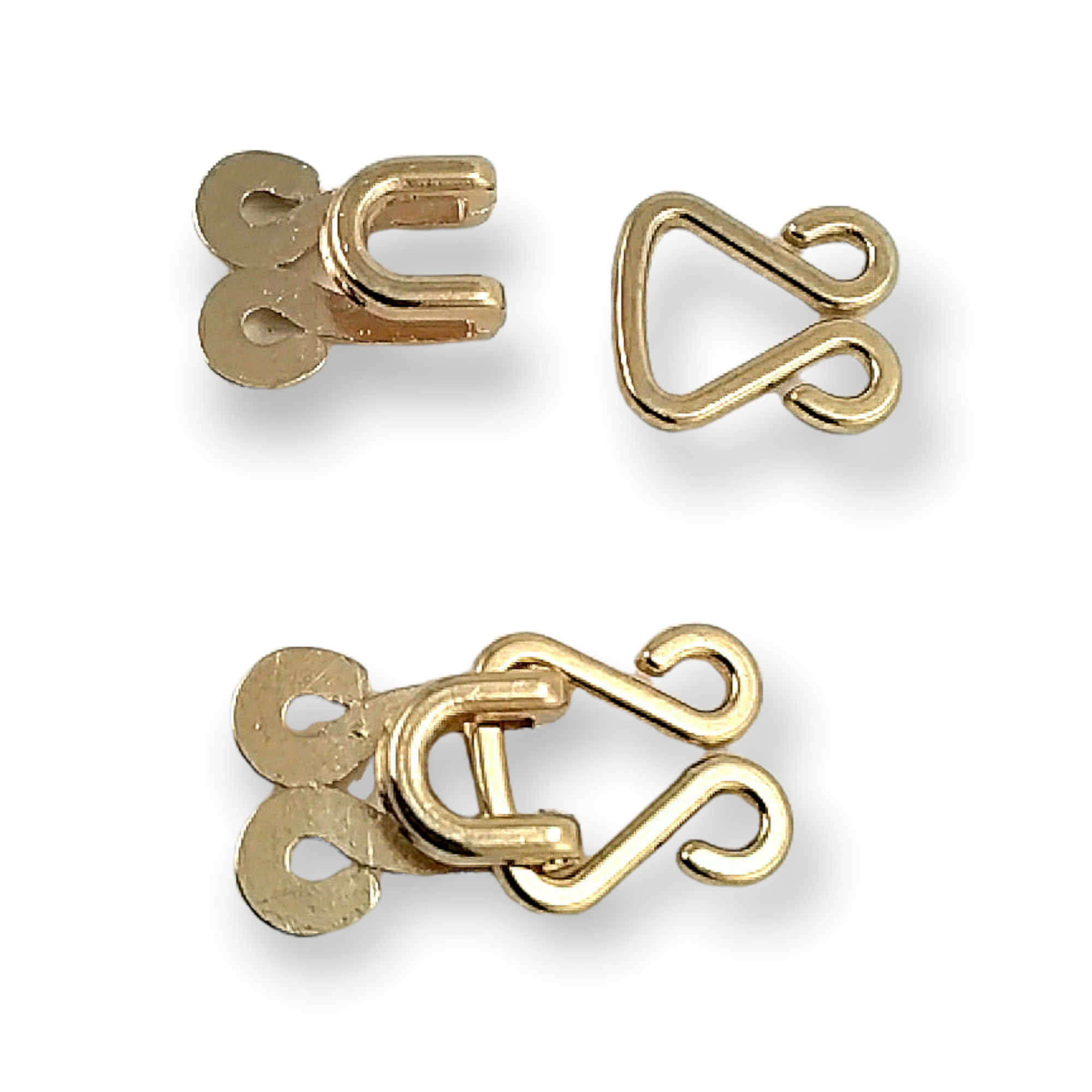
Sew-on installation and sample approval
- Match the pieces: Lay out the hook and corresponding receiver in the intended closing direction.
- Mark the position: Verify alignment while the garment is closed, not only when the fabric is flat.
- Check reinforcement: Prevent distortion or localized stress around the attachment point.
- Secure the component: Use an attachment method that does not obstruct the hook's engagement.
- Test the finished sample: Check repeated opening and closing, user comfort and whether the edges sit neatly.
Choosing between concealed and decorative closures
If a fastening should remain invisible, prioritize low profile, placement and ease of operation. For an intentionally visible jacket clasp, inspect finish, proportions and construction on the final fabric. For bulk apparel sourcing, record the approved model code, sample and mating component so repeat orders are not based on an ambiguous product nickname.
Compare the real models in the Related Products section below this article. Confirm the exact measurement point, finish, availability and package conditions on each live listing. For manufacturing orders, approval on the intended fabric is preferable to selecting from photos alone.
↑ Review the model comparisonBrowse the hook-and-eye fastener category and compare E 1763 14.5 mm with E 1762 7.5 mm. Confirm sewing width and component compatibility on each live product page.
Frequently asked questions
Is a frog fastening always the same as a hook-and-eye?
Not necessarily. Decorative frog fastenings can use specific shapes or materials. Check each product's physical connection method before substitution.
Does a 14.5 mm label mean overall width?
No. For example, the referenced E 1763 model uses 14.5 mm for its sewing section; other dimensions must be checked separately.
Can hook-and-eye closures be used with zippers?
Certain waistband and garment designs use an additional hook closure near a zipper. The correct construction depends on the garment and its intended operation.
How should a factory approve a garment hook?
Confirm the mating components, evaluate stitching on production fabric and check closure function on a finished sample before bulk use.
Are magnetic clasps hook-and-eye fasteners?
No. Magnetic clasps and mechanical hooks work differently and require different application checks.
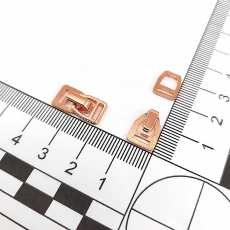
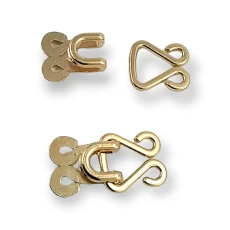

.jpg-230x230.webp "1 cm - 0,39")
.jpg-230x230.webp "1 cm - 0,39")
.jpeg-230x230.webp "10 mm / 0.39 in Gold Zamak Bra Strap Slider and Ring Set, 500 Pairs PBT0006PROMO")
.jpg-230x230.webp "10 mm / 0.39 in Gold Zamak Bra Strap Slider and Ring Set, 500 Pairs PBT0006PROMO")
_7_11zon.jpg-230x230.webp "10 mm / 0.394 in Ball-Tip Sew-On Hook Fastener, 50 Pieces E 1879 PROMO")
_10_11zon.jpg-230x230.webp "10 mm / 0.394 in Ball-Tip Sew-On Hook Fastener, 50 Pieces E 1879 PROMO")
-s1351%20(1%20(6).jpeg-230x230.webp "10 mm 0,39")
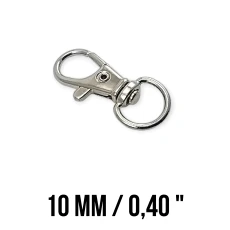
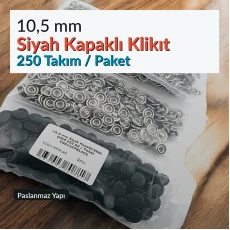
.png-230x230.webp "10.5 mm / 0.41 in Frosted Pearl Stainless Prong Snap Fasteners, 100 Sets/Pack ERBCLK0008BBSD")
.png-230x230.webp "10.5 mm / 0.41 in Frosted Pearl Stainless Prong Snap Fasteners, 100 Sets/Pack ERBCLK0008BBSD")
.png-230x230.webp "10.5 mm / 0.41 in White Pearl Stainless Prong Snap Fasteners, 100 Sets/Pack ERBCLK0008BSD")
.png-230x230.webp "10.5 mm / 0.41 in White Pearl Stainless Prong Snap Fasteners, 100 Sets/Pack ERBCLK0008BSD")
.jpeg-230x230.webp "10.5 mm Stainless Steel Nickel-Plated Perforated Snap Fastener, 250 Pieces/Pack C0011DPK")
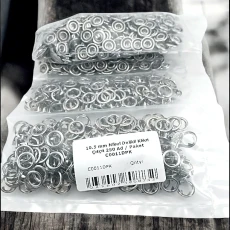
.png-230x230.webp "10.5 mm Stainless Steel Nickel-Plated Snap Fasteners, 250 Pieces/Pack C0011KP")
.png-230x230.webp "100 m / 328.08 ft N5 / #5 Nylon Coil Zipper Chain Set with 50 Single-Pull Sliders for Workshops SET-T10T-NAYLON-100M50C")
.png-230x230.webp "100 m / 328.08 ft N5 / #5 Nylon Coil Zipper Chain Set with 50 Single-Pull Sliders for Workshops SET-T10T-NAYLON-100M50C")
.webp-230x230.webp "12 mm / 0.47 in Silver (Nickel) Stainless Domed Eyelet – 100-Piece Pack ER0026P100")
.webp-230x230.webp "12 mm / 0.47 in Silver (Nickel) Stainless Domed Eyelet – 100-Piece Pack ER0026P100")
_7.jpg-230x230.webp "12.5 mm / 0.49 in 54 System Light Bone Plastic Capped Snap Fastener 100 Sets ERC00125PLKemik")
_4.jpg-230x230.webp "12.5 mm / 0.49 in 54 System Light Powder Plastic Capped Snap Fastener 100 Sets ERC00125PLAPudra")
_10.jpg-230x230.webp "12.5 mm / 0.49 in 54 System Light Salmon Plastic Capped Snap Fastener 100 Sets ERC00125PLSomon")