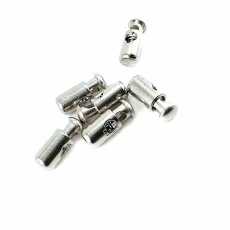
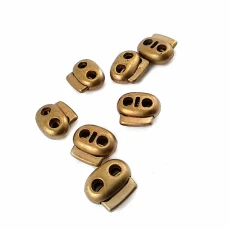
What Is a Cord Lock or Drawstring Stopper?
A cord lock or drawstring stopper is an adjustable textile component used to control the movement of a cord, lace, string or compatible round elastic. When the push mechanism is released, the cord can be moved to the required position. Releasing the mechanism allows the component to apply pressure and help retain the cord.
Cord locks provide a reusable adjustment point for hood openings, waist drawstrings, bag closures, footwear lacing systems and other gathered textile applications.
A cord lock does not finish the cut end of a drawstring. Use cord ends and drawstring tips for the terminal sections. A cord lock and two cord ends may be used together in the same assembly.
Which Cord Lock Should Be Selected?
| Application Requirement |
Model to Consider |
Specification to Check |
| Adjust one cord from one position |
Single-hole cord lock |
Normal and compressed cord diameter |
| Keep two cord ends in separate passages |
Double-hole cord lock |
Internal size of each passage and routing direction |
| Release two ends simultaneously |
Single-button double-hole model |
Compatibility of both passages with the selected cord |
| Use the component on lightweight garments |
Plastic cord lock |
Body weight, colour and cord compatibility |
| Create visible metal hardware |
Zinc-alloy or another verified metal cord lock |
Base metal, finish, weight and fabric contact |
| Use a flat drawstring or narrow elastic |
Rectangular-entry cord lock |
Drawstring width and thickness |
| Use a compact rounded component |
Ball, mine, crescent or semicircular model |
Outside body dimensions and operating comfort |
| Create a slim elongated appearance |
Long or flat cord lock |
Body direction, cord route and push area |
Metal and Plastic Cord-Lock Categories
Metal Cord Locks
Metal cord locks are mainly zinc-alloy models offered in different finishes and body shapes. The range may include single-hole, double-hole, round, flat, cube, ball, mine, crescent and other model-specific designs.
A metal model may be selected when the cord lock is intended to form a visible part of the product design. Component weight and surface contact should be tested on lightweight hoods, fine textiles and delicate materials.
Plastic Cord Locks
Plastic cord locks may be selected where low weight, colour choice and everyday operating convenience are priorities. The range includes single- and double-hole, elongated, flat, rounded, mine, crescent and other model structures.
A plastic body does not corrode like exposed metal, but the internal spring, operating section, polymer, colour treatment, wash temperature and intended environment must still be assessed separately.
Single-Hole and Double-Hole Cord Locks
A single-hole cord lock provides one shared passage. It is normally used with one cord. Two fine ends may be used together only where their combined compressed dimensions are compatible with the channel.
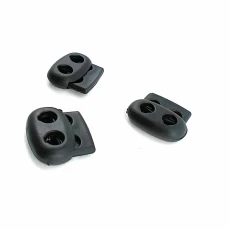
A double-hole cord lock places two cord ends in separate passages. It may help keep the ends parallel and reduce twisting on hood, waistband and bag applications.
More holes do not automatically create stronger holding performance. Grip depends on cord dimensions, surface friction, spring pressure and internal passage geometry.
| Cord-Lock Structure |
Cord Arrangement |
Selection Note |
| Single hole |
One shared passage |
For one cord or compatible fine ends using the same route |
| Double hole |
Two separate passages |
For keeping two ends separate and parallel |
| Single-button double hole |
Both passages are released by one operating button |
For adjusting both ends at the same time |
| Side-bridge model |
Passage and push direction vary by design |
Check user access and body orientation on the finished product |
Top-Push and Side-Operated Cord Locks
On a top-push cord lock, the operating button is positioned on the upper section of the body. Pressing it releases or aligns the internal passage so that the cord can be repositioned.
On a side-operated or bridge model, the operating direction and cord route vary according to the body design. Check whether the component remains easy to grip and operate in its installed orientation.
Operating comfort depends on button travel, spring pressure, cord rigidity and the way the component is held.
How to Measure Cord Compatibility
The stated opening is the nominal internal passage through which the cord travels. Two cords with the same nominal outside diameter may behave differently because of braid, filling and surface construction.
| Measurement |
Why It Matters |
How to Check It |
| Outside round-cord diameter |
Determines whether the cord can pass through the channel. |
Measure several points with a caliper without flattening the cord. |
| Compressed diameter |
Shows how much a soft or filled cord narrows under spring pressure. |
Compare normal and lightly compressed measurements. |
| Flat-cord width |
Must correspond with the horizontal size of a rectangular passage. |
Measure the widest section. |
| Flat-cord thickness |
Affects vertical passage clearance and mechanism closure. |
Include folded or joined sections where applicable. |
| Surface friction |
A very smooth cord may slip after the mechanism is released. |
Complete a pull test in the actual operating direction. |
| Cord rigidity |
A rigid cord may prevent complete mechanism closure. |
Confirm free button movement with the cord installed. |
Common Cord-Entry Groups
Imperial measurements below are approximate reference conversions. Use the verified individual product dimensions for final selection.
| Entry Size |
General Application Level |
Compatibility Check |
| 3–3.5 mm / 0.12–0.14 in |
Fine strings, small accessories and narrow cords |
Confirm sufficient friction after the mechanism closes. |
| 4–4.5 mm / 0.16–0.18 in |
Hood cords, lightweight bags and standard garment drawstrings |
Check braid density, surface friction and compressed diameter. |
| 5–5.5 mm / 0.20–0.22 in |
Hoodies, tracksuits and medium-weight bag cords |
Confirm that the cord does not slip after locking. |
| 6–7 mm / 0.24–0.28 in |
Filled cords, thick laces and selected round elastic |
Check whether cord rigidity overloads the mechanism. |
| Round entries up to 9 mm / 0.35 in |
Thick cords and specialised textile applications |
Evaluate body size and holding performance. |
| 6 × 3 mm / 0.24 × 0.12 in, 6 × 3.5 mm / 0.24 × 0.14 in and 7 × 3 mm / 0.28 × 0.12 in |
Fine flat or oval-profile drawstrings |
Measure width and thickness separately. |
| 8 × 4 mm / 0.31 × 0.16 in, 8 × 4.5 mm / 0.31 × 0.18 in and 10 × 3.5 mm / 0.39 × 0.14 in |
Wider flat drawstrings and model-compatible narrow elastic |
Confirm free movement and secure locking inside the passage. |
These measurements are general selection references and do not guarantee compatibility. Manufacturing tolerance, braid, filling and surface finish can change the fit.
How Does a Cord Lock Hold the Cord?
On a spring-loaded cord lock, the cord passes through openings in the body and moving button. Releasing the button moves the openings away from full alignment, allowing the mechanism to apply pressure and restrict movement.
Holding performance depends on several factors:
- Actual cord thickness relative to the passage
- Surface-friction level
- Soft, filled, rigid or elastic cord construction
- Internal channel and spring geometry
- Direction and level of the applied pulling force
- Cord position inside single or double passages
Metal and Plastic Cord Locks Compared
| Feature |
Metal Cord Lock |
Plastic Cord Lock |
| Base material |
Mainly zinc alloy or another metal stated on the product page |
Plastic, acetal or another polymer stated on the product page |
| Weight |
May create a heavier and more visible hardware detail. |
Adds less weight to lightweight textile products. |
| Appearance |
Nickel, black nickel, gold, antique brass, gunmetal and painted finishes may be available. |
Black, white, coloured, transparent and model-specific surfaces may be available. |
| Typical priority |
Metal appearance and coordination with other hardware |
Low weight, colour matching and everyday operation |
| Effect on delicate textiles |
Weight and surface contact should be sample tested. |
May be lighter, but edges and mould marks should still be checked. |
| Wet-environment assessment |
Depends on the verified base metal and finish. |
The body, internal spring and colour treatment must be considered. |
A metallic colour or plated surface does not prove that the component is stainless steel or suitable for saltwater exposure.
Cord Locks and Cord Ends Are Different Components
| Feature |
Cord Lock / Drawstring Stopper |
Cord End / Drawstring Tip |
| Main function |
Adjusts cord length or gathering. |
Finishes the cut end of a cord. |
| Position |
Moves along the cord. |
Remains at the terminal section. |
| Adjustment |
Can be released and repositioned. |
Normally remains fixed after fitting. |
| Combined use |
A cord lock may provide adjustment while cord ends finish the terminal sections. |
Real-World Applications
- Hoodie, coat and jacket adjustment cords
- Tracksuit, shorts and sportswear waist drawstrings
- Bag, backpack, pouch and drawstring-sack closures
- Shoe, boot and trainer lacing systems
- Adjustment cords on hats, headwear and neck warmers
- Camping bags, sleeping bags and compatible outdoor textiles
- Curtain, cover and home-textile gathering systems
- Adjustment points using compatible round elastic
How Is a Cord Lock Installed?
- Measure the normal and lightly compressed cord dimensions.
- Press the operating button to align or release the cord passages.
- Thread the cord through the correct passage and direction.
- On a double-hole model, position the two ends in separate passages.
- Release the button and check whether the mechanism retains the cord.
- Pull in the actual operating direction to test slipping.
- Where cord ends will be fitted afterwards, install them after completing the cord route.
Standard push-button cord locks are normally installed by hand and do not require a press or setting die. A separate tool may be required for any terminal cord end fitted afterwards.
Incorrect Selection and Use Warnings
- A cord that is too narrow may slip after the mechanism is released.
- A cord that is too thick may not pass through, may become damaged or may prevent complete button closure.
- Measure both width and thickness when using a flat drawstring.
- Check the compressed diameter of soft and filled cords.
- A very smooth cord may slip despite having a suitable nominal size.
- The number of holes does not determine holding strength by itself.
- A heavy metal cord lock may pull or distort lightweight fabric.
- A fitted cord end may not pass through a cord-lock channel or eyelet.
- Plastic or metal appearance alone does not confirm wash or outdoor suitability.
- Small-part and detachment risks must be assessed separately for children’s products.
- Complete a sample test with the actual cord and finished product before wholesale ordering or mass production.
Related Categories
Frequently Asked Questions About Cord Locks
What does a cord lock or drawstring stopper do?
A cord lock helps adjust the usable length or gathering of a cord and retain it at the selected position.
How do I select the correct cord-lock size?
Measure the outside diameter and, for soft cord, the lightly compressed diameter. For flat drawstrings, measure width and thickness separately and compare them with the verified internal passage.
Is matching the nominal cord and opening size sufficient?
No. Braid density, filler hardness, surface friction and compressibility can change holding performance. Complete a sample test.
What is the difference between single-hole and double-hole cord locks?
A single-hole cord lock has one shared passage. A double-hole model keeps two ends in separate passages. The number of holes does not determine holding strength by itself.
Why does the cord slip through the lock?
The cord may be too narrow, too smooth or too rigid for the selected mechanism. Spring and channel design also affect compatibility. A smaller opening or different mechanism may be required.
Does a cord lock require a press or setting die?
Standard push-button cord locks are normally installed by hand. Press the button to release the passage and thread the cord through it. A separate tool may be required for a terminal cord end.
Can a cord lock be used with round elastic?
It may be used when the opening and mechanism are compatible. Because elastic changes diameter under compression and tension, test it with the actual material.
Should I choose a metal or plastic cord lock?
Consider plastic where low weight and colour matching are priorities. Consider metal where visible hardware is required. Test both cord compatibility and finished-product performance.
Should the cord lock or cord end be installed first?
If the completed cord end is larger than the lock passage, thread the cord lock first and fit the terminal cord end after completing the cord route.
Are all metal cord locks stainless?
No. Products are commonly manufactured from zinc alloy or other metals. Verify the exact base metal and finish on the individual product page.
Is sample testing required before wholesale production?
Yes. A sample confirms entry compatibility, grip, operating comfort, component weight, colour and appearance on the completed product.
Last updated: 21 July 2026
Business and brand: E-Düğme – Istanbul, Türkiye
Technical verification note: Refer to the individual product page for exact metric and imperial entry dimensions, body size, base material, finish, colour, pack quantity and mechanism structure.

.jpg-40x40.webp "Magnetic Snaps Buttons")

.jpg-40x40.webp "Prong Snap Fasteners for Baby Clothes")


.jpg-40x40.webp "Curved Snaps Buttons")


.jpg-40x40.webp "Snap Fasteners Half Dome type")
-no5-k0010%20(3).jpg-40x40.webp "Eyetlets")


-K0014.png-40x40.webp "Steel Eyelets and Iron Metal Grommets")

.jpg-40x40.webp "Flat Brass Eyelets and Grommets")

.jpg-40x40.webp "Aluminum Eyelets and Grommets")


.jpg-40x40.webp "Galvanized Eyelets and Grommets")


.jpg-40x40.webp "Hole Cutter Tools and Punching Dies")

.jpg-40x40.webp "Grommet Punching Dies")


.jpg-40x40.webp "Pearls Types")


.jpg-40x40.webp "Rivets")


.jpg-40x40.webp "Water-Repellent Jacket Zippers")


.jpg-40x40.webp "Tires")

.jpg-40x40.webp "Round Braided Elastic Cord")


.png-40x40.webp "Enameled Buttons")


.png-40x40.webp "Two Hole Sewing Buttons")


.jpg-40x40.webp "Carabiner Clips, Snap Hooks and Bag Hooks")


-PhotoRoom.png-40x40.webp "Spring Rings, Key Rings and Snap Clamps")


.png-40x40.webp "Hook and Eye Closures Sew-On")


.png-40x40.webp "Bag Making Kits")

.png-40x40.webp "Continuous Zipper Sets")


.jpg-40x40.webp "Bra Underwires")




-no5-k0010%20(3).jpg-590x590.webp "Eyelets and Grommets")
.jpg-590x590.webp "Rivets")
.jpeg-100x100.webp "Two Hole Metal Stopper 4.5 mm - 0,18\" Hole Diameter Pistachio Green Aesthetic Model - Zinc Alloy Stopper CGT0001PROMO")
.jpg-100x100.webp "Metal Stopper 50 Pcs/Pack Nickel Plated 4.5 mm Hole Diameter Stopper NS004500PROMO")
.jpg-100x100.webp "Mine Stopper 15 mm Antique Brass 50 pcs/Packet E 2206PROMO")

.jpg-100x100.webp "Plastic Stopper for Two-Hole Planter Blue 100 Pieces/Pack H001707Pr213")
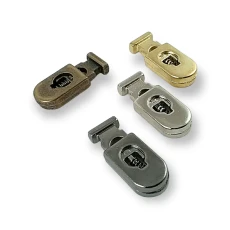
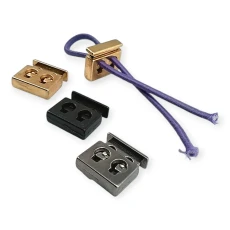

.jpg-230x230.webp "Cube Stopper Two Holes 4 mm 0,16\" Hole Diameter Top Press - Elegant and Aesthetic Model Stopper CGT0009")
.jpg-230x230.webp "Metal Stopper Two Hole 5.5 mm - 0,22\" Hole Diameter Stylish and Aesthetic Model - Zamak Stopper CGT0005")
.jpeg-230x230.webp "Two Hole Metal Stopper 4.5 mm - 0,18\" Hole Diameter Stylish and Aesthetic Model - Zamak Stopper CGT0001")