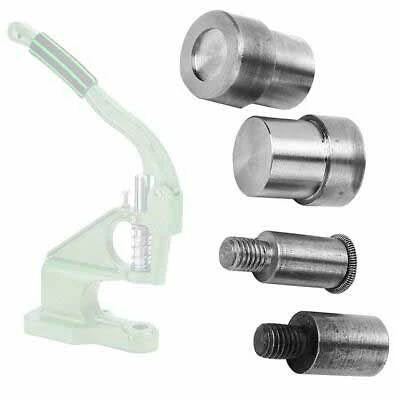
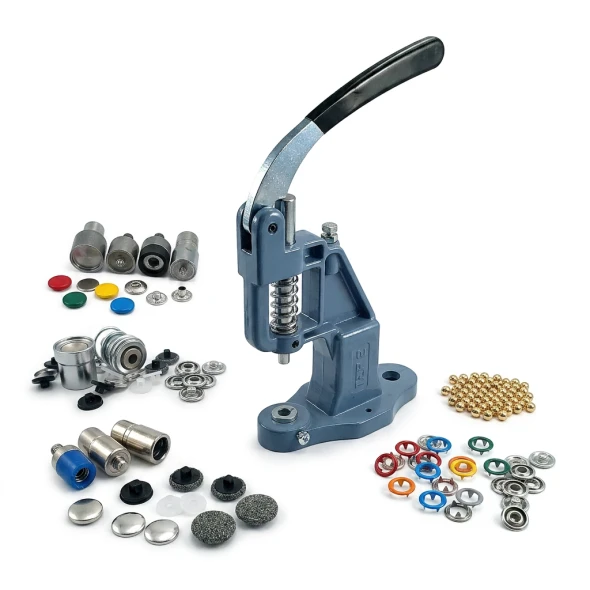
What Are Grommet Punching Dies?
Grommet punching dies are cutting tools used to prepare clean and accurate holes before installing eyelets, grommets or cap-style metal accessories. They can be used on fabric, leather, faux leather, canvas, tarpaulin, awning fabric, tent fabric, vinyl banners, bags, footwear and technical textile surfaces.
These tools do not install the eyelet. A punching die only prepares the hole where the eyelet or grommet will pass through. After the hole is opened, the eyelet should be installed with a compatible eyelet setting die or application tool.
This category belongs to the fastening molds, stud dies and apparatus group. It includes round punching dies for standard eyelets and special oval punching dies for oval eyelets.
Punching Dies and Setting Dies Are Not the Same
Eyelet installation has two separate steps. The first step is preparing the hole. This is done with a grommet punching die. The second step is installing the eyelet or cap into that hole. This requires a setting die or application tool.
| Tool Type |
Function |
When to Use |
| Grommet Punching Die |
Opens the hole where the eyelet or grommet will pass through. |
Used before installation when a clean and accurate hole is required. |
| Eyelet Setting Die |
Installs the eyelet and washer into the prepared hole. |
Used after the hole has been opened. |
| Self-Piercing Setting Die |
Can support punching and setting in one operation for compatible systems. |
Used only with suitable self-piercing eyelet structures. |
In simple terms, the punching die opens the hole; the setting die installs the eyelet. These two tools should not be used interchangeably.
Difference Between Round and Oval Grommet Punching Dies
Round grommet punching dies create circular holes for standard round eyelets. They are used in common fabric, leather, bag, tarpaulin, awning, banner and footwear applications.
Oval grommet punching dies create elongated holes that match the form of oval eyelets. A round punching die should not be used for oval eyelets. If the hole form does not match the oval eyelet body, the eyelet may not sit correctly, the edges may remain unsupported, or the final installation may look uneven.
| Punching Die Type |
Hole Form |
Typical Use |
What to Check |
| Round Grommet Punching Die |
Circular hole |
Standard round eyelets, tarpaulins, leather, textiles, banners and bags |
Hole diameter should match the real inner diameter and material thickness. |
| Oval Grommet Punching Die |
Oval / elongated hole |
Oval eyelets, tarpaulins, tents, shade systems, caravan equipment, marine covers and technical textiles |
The oval hole length and width should match the oval eyelet form and setting die. |
Punching Die Measurements in This Category
This category includes different round and oval punching dies for various eyelet and grommet applications. When choosing a die, the punch measurement should be checked together with the real inner diameter, outer diameter, barrel height and material thickness of the eyelet.
Round Grommet Punching Dies
Round punching dies are used for standard circular eyelet holes. They cover applications from small textile eyelets to larger tarpaulin and technical textile eyelet systems.
| Punching Die Measurement |
Approx. Inch Equivalent |
Typical Use |
| 3.5 mm |
0.14 in |
Thin fabrics, small accessories and precise small hole preparation |
| 5 mm |
0.20 in |
Textiles, footwear, small leather goods and light eyelet applications |
| 5.5 mm |
0.22 in |
Small and medium eyelet hole preparation |
| 10 mm |
0.39 in |
Bags, leather goods, textiles and general eyelet applications |
| 12 mm |
0.47 in |
Medium eyelets, tarpaulin and textile applications |
| 13 mm |
0.51 in |
Bags, tarpaulin, technical fabrics and wider hole preparation |
| 17.3 mm |
0.68 in |
Tarpaulins, awnings, tents and larger eyelet applications |
| 28 mm |
1.10 in |
Large tarpaulin, awning and technical textile applications |
Oval Grommet Punching Dies
Oval punching dies prepare oval-shaped holes so that oval eyelets can sit correctly on the surface. They do not create circular holes; they create an elongated opening that follows the oval eyelet form.
| Oval Punching Die Measurement |
Approx. Inch Equivalent |
Typical Use |
| 5 mm |
0.20 in |
Small oval eyelet and accessory applications |
| 10 mm |
0.39 in |
Bags, leather accessories, light tarpaulin and small oval eyelet applications |
| 15 mm |
0.59 in |
Tarpaulins, tents, shade systems and technical textiles |
| 20 mm |
0.79 in |
Medium to large oval eyelet applications |
| 25 mm |
0.98 in |
Caravan equipment, shade systems, tarpaulins and wider oval openings |
| 30 mm |
1.18 in |
Large oval eyelets, tarpaulins, marine covers and technical textiles |
How to Choose the Correct Grommet Punching Die
The correct punching die should be selected according to the actual hole required by the eyelet or grommet. Inner diameter, outer diameter, barrel height, washer structure and material thickness should be evaluated together.
Visually similar eyelets may require different hole measurements. For this reason, the product name alone is not enough for choosing the correct punching die. Hole preparation should be checked especially for stainless steel eyelets, coin-style eyelets, narrow-rim eyelets and double-sided eyelets.
| Information to Check |
Why It Matters |
| Hole measurement |
It determines how the eyelet will sit on the surface. |
| Real inner diameter |
It should match the punching opening. |
| Outer diameter |
It affects the visible surface coverage of the eyelet. |
| Barrel height |
It affects closing quality after installation. |
| Washer or non-washer structure |
Washer-supported systems require more accurate hole preparation. |
| Material thickness |
Leather, canvas, tarpaulin and textile thickness can change the required punch selection. |
| Press compatibility |
The punching die must be compatible with the press or machine connection. |
Punching Dies for Tarpaulins, Awnings and Tents
In tarpaulin, awning and tent applications, eyelets are often used on thicker materials and may be exposed to stronger pulling forces. For this reason, the hole must be prepared accurately.
If the hole is too large, the eyelet may stay loose. If the hole is too small, the eyelet may not sit properly and the surface may deform during installation. For tarpaulin and awning applications, the punching die, eyelet, washer and setting die should be selected as a complete system.
Punching Dies for Leather, Bags and Footwear
In leather, faux leather, bag and footwear applications, a clean hole edge is important for the final appearance. Using the wrong punching tool can cause tearing, stretching or uneven edges on the leather surface.
The punching die should be selected together with the eyelet measurement and the setting die that will be used after punching. The cleaner the hole edge, the more professional the final eyelet appearance will be.
Punching Dies for Vinyl Banners and Advertising Prints
Vinyl banners and advertising prints require clean hole preparation before grommet installation. A correct punching die helps the grommet close without tearing or distorting the printed surface.
For repeated banner production, the punching die, press system and setting tool should be planned together. Press compatibility is important for keeping the same hole measurement in repeat applications.
Press and Machine Compatibility
Grommet punching dies can be used with different press and machine systems depending on their connection structure. Not every die fits every machine. Before ordering, the die connection, thread structure, press standard and machine type should be checked.
For repeated installation work, the mounting machines and hand tools category can also be reviewed.
Common Mistakes
- Using a punching die as a setting die
- Choosing an oval punching die for a round eyelet
- Using a round punching die for an oval eyelet
- Opening a hole that does not match the eyelet structure
- Making the hole too large
- Ignoring material thickness
- Not checking press compatibility
- Using the same punching die for different eyelet constructions
- Selecting the punching die and setting die separately without checking compatibility
Frequently Asked Questions
What does a grommet punching die do?
It opens the hole required before installing an eyelet or grommet.
Does a grommet punching die install the eyelet?
No. A punching die only opens the hole. A setting die is required to install the eyelet.
Are round and oval punching dies the same?
No. A round punching die creates a circular hole. An oval punching die creates an elongated hole that matches the oval eyelet form.
Can a round punching die be used for oval eyelets?
No. Oval eyelets require a special oval punching die.
Which punching measurement should I choose?
The die should be selected according to the eyelet’s real inner diameter, outer diameter, barrel height, washer structure and material thickness.
Is a punching die required for tarpaulin applications?
In most tarpaulin applications, a punching die is needed to prepare a clean and accurate hole before installation.
Why is a punching die important for leather goods?
It helps create a clean hole edge and reduces the risk of tearing or uneven edges on the leather surface.
What happens if the hole is too large?
The eyelet may stay loose, rotate on the surface or fail to close properly.
What happens if the hole is too small?
The eyelet may not sit correctly and the material may deform during installation.
Which presses can be used with grommet punching dies?
Depending on the connection structure, they can be used with hand-setting tools, hand presses, impact presses, electric machines and pneumatic systems.