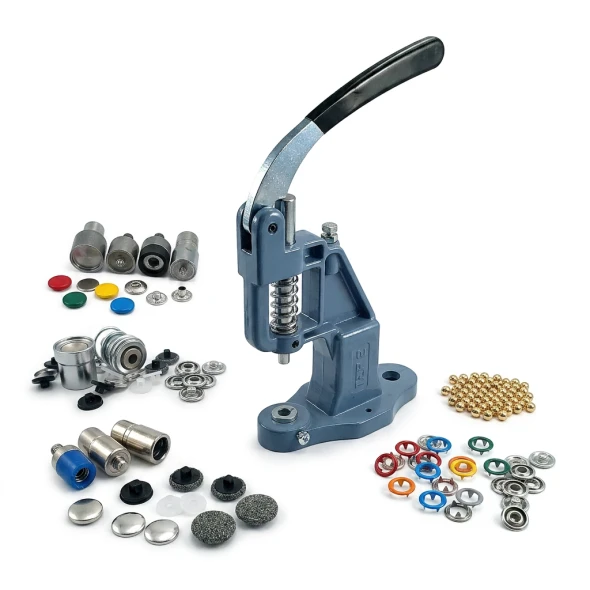
Narrow-Edged Brass Eyelets
Narrow-edged eyelets are brass eyelet components selected when a slimmer visible metal rim is needed around a passage hole. They can be used on bags, footwear, leather goods, textile products, curtains, tarpaulins, covers and accessories where rope, cord, lace, elastic or fastening elements pass through the surface.
A narrow-edged eyelet is not selected only for decoration. The inner diameter must match the item passing through it, the barrel length must suit the total material thickness and the setting die must match the eyelet construction. These checks help create a cleaner and more balanced installation result.
What Is a Narrow-Edged Eyelet?
A narrow-edged eyelet is an eyelet with a slimmer visible outer rim compared with wider-rim eyelet constructions. This can create a more controlled metal detail on the product surface when a large visible flange is not preferred.
Narrow-edged eyelets may be curved or flat. Curved models create a more rounded and dimensional visible cap, while flat models create a lower-profile surface finish. The correct option depends on product design, material thickness and the desired amount of visible metal detail.
Where Are Narrow-Edged Eyelets Used?
| Application Area |
Why Choose a Narrow-Edged Eyelet? |
What to Check |
| Bags and leather accessories |
Creates a more controlled metal rim around cords, straps or decorative passages. |
Check leather thickness, cord diameter and outer rim proportion. |
| Footwear and boots |
Can provide a more compact metal detail around lace passages. |
Check lace diameter, upper material and eyelet setting suitability. |
| Textiles and outerwear |
Can create a cleaner metal detail around drawstrings, elastics or decorative openings. |
Check fabric layers, reinforcement and hole preparation. |
| Curtains and home textiles |
Can provide a more understated metal rim where a large flange is not desired. |
Check rod, cord or passage diameter against the inner diameter. |
| Tarpaulins and technical textiles |
Can be considered where a slimmer visible rim is required around selected tie or passage points. |
Check material thickness, load, barrel length and compatible setting die. |
Narrow-Edged Eyelet Sizes
| Eyelet Type |
Inner Diameter |
Outer Diameter |
Barrel Length |
Profile |
| Narrow-Edged Brass Eyelet |
8 mm / 5/16 in |
13.5 mm / 0.53 in |
5.4 mm / 0.21 in |
Curved |
| Narrow-Edged Brass Eyelet |
9.3 mm / 23/64 in |
16 mm / 0.63 in |
5.3 mm / 0.21 in |
Curved |
| Narrow-Edged Brass Eyelet |
15.5 mm / 39/64 in |
21.5 mm / 0.85 in |
8.3 mm / 0.33 in |
Flat |
Measurement note: Eyelet labels and size references can vary between manufacturers. Use the product page specifications for inner diameter, outer diameter, barrel length and compatible setting dies as the final reference before ordering.
Narrow-Edged Eyelets vs Domed Eyelets
Domed eyelets are selected when a raised and more visible rounded cap is desired. Narrow-edged curved eyelets retain a rounded profile while reducing the visible outer rim area. This can be useful when a more compact metal detail is preferred.
For wider comparison across eyelet constructions, review eyelets and grommets. Select the final eyelet according to material thickness, passage size, visible rim preference and setting compatibility.
Narrow-Edged Eyelets vs Flat Eyelets
Flat eyelets create a lower-profile finish on the application surface. Narrow-edged flat eyelets combine this lower profile with a more controlled visible rim. They can be useful where a wide cap appearance is not wanted but a clean metal passage point is still required.
Hole Preparation and Setting Die Compatibility
Hole preparation should match the eyelet barrel and material thickness. A hole that is too small can prevent correct seating, while a hole that is too large can create a loose or uneven installation.
Use a setting die that matches the eyelet form and size. Depending on the application, eyelets can be installed with hand-setting tools, hand presses, impact presses, electric machines or pneumatic machines. Check eyelet size, barrel length, material thickness and die compatibility as one complete system.
Frequently Asked Questions
What is a narrow-edged eyelet?
A narrow-edged eyelet is an eyelet with a slimmer visible outer rim. It can be selected when a more controlled metal detail is preferred around a cord, lace or rope passage.
Where are narrow-edged eyelets used?
They can be used on bags, footwear, leather goods, textiles, curtains, tarpaulins, covers and accessory products.
What is the difference between narrow-edged and domed eyelets?
Domed eyelets have a more pronounced rounded cap profile. Narrow-edged eyelets focus on reducing the visible outer rim area and can be curved or flat.
How do I choose between 8 mm, 9.3 mm and 15.5 mm inner diameters?
Select the inner diameter according to the rope, cord, lace or fastening element that will pass through the eyelet. Also check barrel length and total material thickness.
Do narrow-edged eyelets require a setting die?
Yes. A compatible setting die is needed for cleaner installation and correct eyelet formation.
E-Dugme Narrow-Edged Eyelets
In the E-Dugme narrow-edged eyelets category, buyers can compare 8 mm / 5/16 in, 9.3 mm / 23/64 in and 15.5 mm / 39/64 in brass eyelets in curved and flat constructions. Matching the correct inner diameter, barrel length, visible rim and setting die helps achieve a cleaner eyelet result for bags, footwear, leather, textiles, curtains and tarpaulins.
 Snap Fastener
.jpg-40x40.webp "Curved Snaps Buttons") Curved Snaps Buttons0
Curved Snaps Buttons0
 Coin Type Snap Fasteners0
.jpg-40x40.webp "Prong Snap Fasteners for Baby Clothes") Prong Snap Fasteners for Baby Clothes0
Prong Snap Fasteners for Baby Clothes0
 Coat Snap Buttons0
 Deluxe Series Snap Buttons0
 Wallet Snaps Buttons - VT2 Snaps Buttons0
 Sew-On Snap Fasteners0
 Stainless Snap Fasteners0
 Brass Snap Fasteners0
 Snap Fasteners - Iron Metal0
 Zinc Alloy Snap Fasteners0
.jpg-40x40.webp "Snap Fasteners Half Dome type") Snap Fasteners Half Dome type0
Snap Fasteners Half Dome type0
.jpg-40x40.webp "Magnetic Snaps Buttons") Magnetic Snaps Buttons0
Magnetic Snaps Buttons0
 Plastic Snap Fasteners0
 Hidden Snap Fasteners0
-no5-k0010%20(3).jpg-40x40.webp "Eyetlets") Eyetlets
Eyetlets
 Brass Eyelets0
 Stainless Steel Eyelets0
 Plastic Eyelets and Grommets0
-K0014.png-40x40.webp "Steel Eyelets and Iron Metal Grommets") Steel Eyelets and Iron Metal Grommets0
Steel Eyelets and Iron Metal Grommets0
 Zamak Zinc Alloy Eyelets and Grommets0
 Oval Eyelets and Grommets0
 Domed Brass Eyelets and Grommets0
.jpg-40x40.webp "Flat Brass Eyelets and Grommets") Flat Brass Eyelets and Grommets0
Flat Brass Eyelets and Grommets0
 Double-Sided Eyelets0
 Narrow-Edged Eyelets0
 Coin Type Eyelets0
 Long Barrel Eyelets and Grommets0
 Short Barrel Eyelets and Grommets0
 Mesh Eyelets and Ventilation Grommets0
.jpg-40x40.webp "Aluminum Eyelets and Grommets") Aluminum Eyelets and Grommets0
Aluminum Eyelets and Grommets0
.jpg-40x40.webp "Galvanized Eyelets and Grommets") Galvanized Eyelets and Grommets0
Galvanized Eyelets and Grommets0
 Pleated Fly Screen and Pleated Blind Eyelets0
 Application Mold
 Grommet Dies & Setting Tools0
.jpg-40x40.webp "Grommet Punching Dies") Grommet Punching Dies0
Grommet Punching Dies0
.jpg-40x40.webp "Hole Cutter Tools and Punching Dies") Hole Cutter Tools and Punching Dies0
Hole Cutter Tools and Punching Dies0
 Trouser and Skirt Hook and Bar Assembly Patterns0
 Rivet Assembly Tools0
 Jeans Button Assembly Tools0
 Pearl Mounting Accessories0
 Fabric Covered Button Tools0
.jpg-40x40.webp "Pearls Types") Pearls Types
Pearls Types
 Fabric Covered Buttons
 Jeans Buttons
 Zippers
.jpg-40x40.webp "Tires") Tires
Tires
 Ready-Made Kits


.jpg-40x40.webp "Water-Repellent Jacket Zippers")


.jpg-40x40.webp "Round Braided Elastic Cord")


.png-40x40.webp "Bag Making Kits")

.png-40x40.webp "Continuous Zipper Sets")


-no5-k0010%20(3).jpg-590x590.webp "Eyelets and Grommets")
.jpg-590x590.webp "Rivets")