What Are Locking Rings?
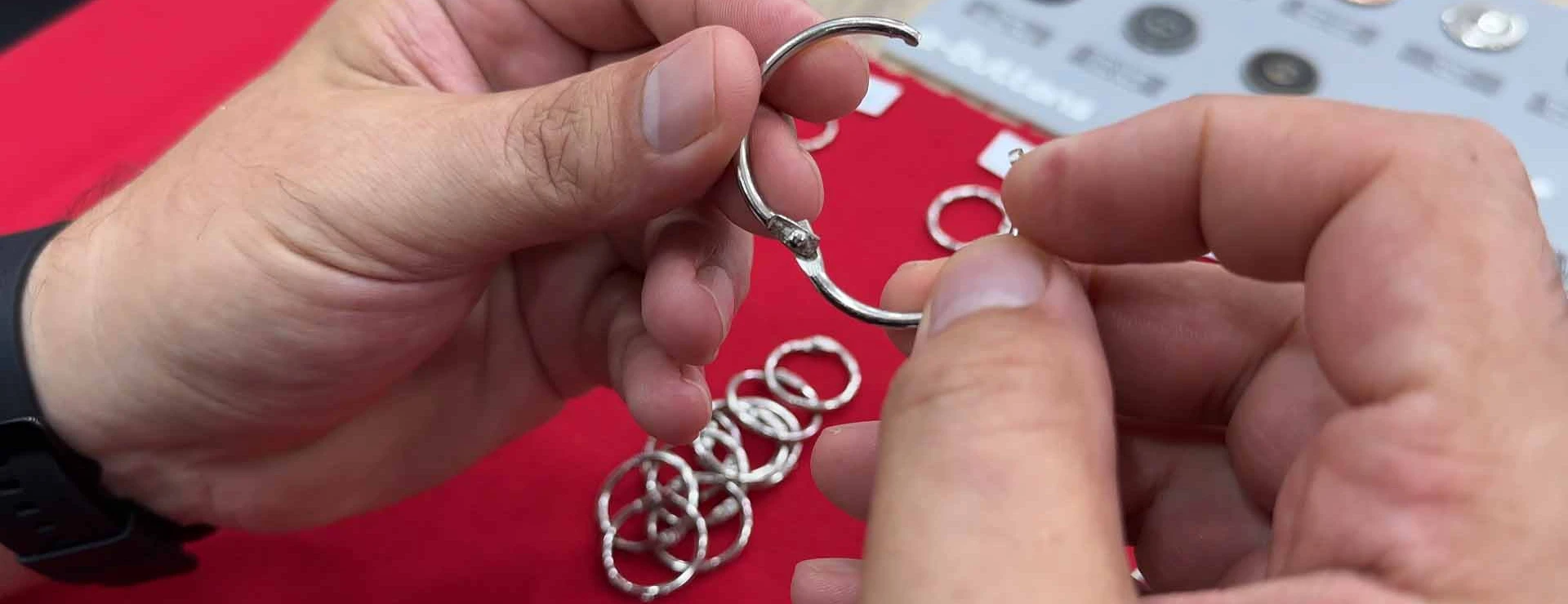
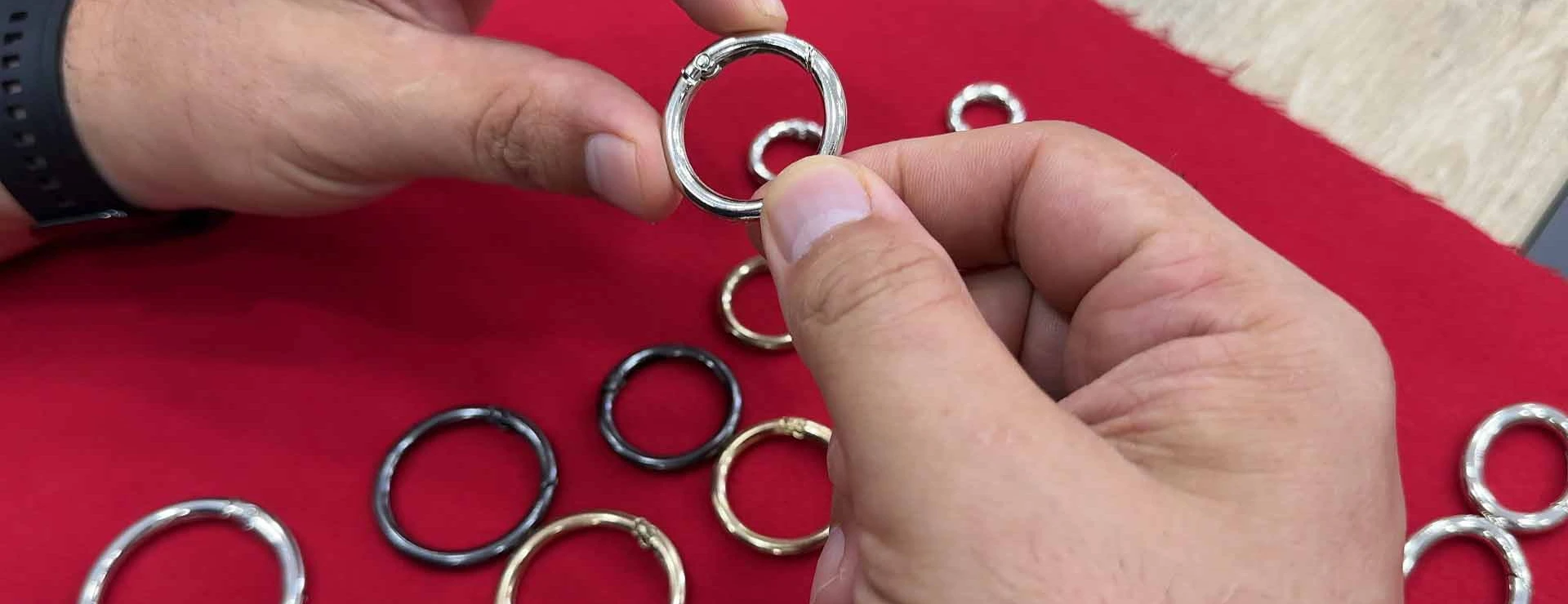
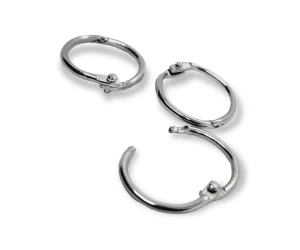
Locking rings are openable metal rings designed to connect separate parts in a circular system. The ring opens at its closing section so a chain link, strap end, tag, calendar page, wallet chain, accessory fitting or similar component can be placed inside. Once closed, the product returns to a continuous ring form.
They are commonly used where a permanent closed ring would make assembly difficult. Typical applications include desktop calendars, catalogues, sample books, swatch cards, wallet chains, keychains, camera straps, bag accessories, leather tabs, decorative chains and compact textile accessory systems.
Locking rings can also be searched as openable metal rings, calendar rings, binder rings, catalogue rings, wallet-chain rings or bag connection rings. These terms describe different application contexts, but the selection principle remains the same: the ring must have enough usable inner space and opening clearance for the connected material.
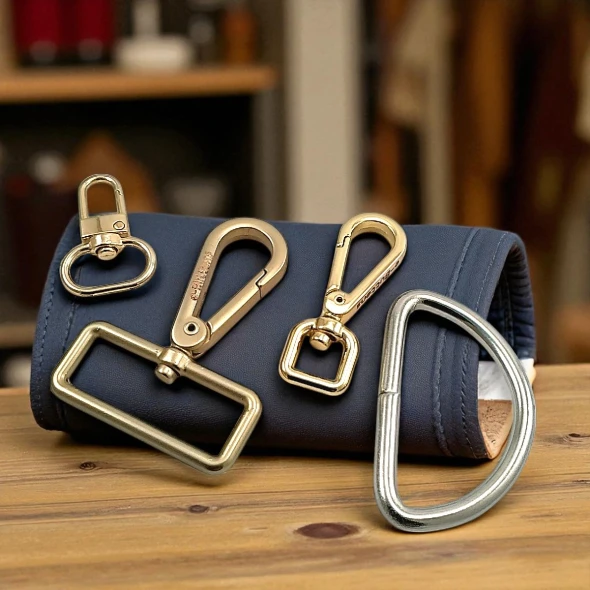
For broader bag and strap hardware planning, browse the Bag Buckles, Rings and Hooks collection. This allows locking rings to be matched with hooks, fixed rings, chains, rivets and other visible hardware components in the same project.
How Does a Locking Ring Work?
A locking ring has an opening and closing section that creates temporary access to the inside of the ring. The required chain, strap fitting, paper stack, tag, eyelet, hook or accessory part is placed through this opening. After the connection is assembled, the ring is closed to form a complete circular connection point.
The ring should be selected according to the actual thickness and shape of the attached material. A ring that is too small can limit movement or make assembly difficult. A ring that is unnecessarily large can create excessive play in compact accessories, small chains or lightweight tag systems.
Locking Ring, Spring Ring, Key Ring and Fixed O Ring
These products may appear similar because all use a ring-shaped form, but they perform different connection functions. Choosing the correct type helps avoid unnecessary movement, difficult assembly or unsuitable connection methods.
| Hardware Type |
Connection Method |
Typical Application |
| Locking Ring |
Openable and closable ring section for controlled assembly |
Calendars, catalogues, wallet chains, camera straps, bags and accessory systems |
| Spring Ring |
Spring-gate opening for practical attachment of compatible components |
Bag charms, chains, short straps, wallets and compact accessories |
| Key Ring |
Fixed split-ring structure for holding keys, tags and small accessories |
Keychains, promotional products, metal tags and bag charms |
| D Ring / O Ring |
Fixed connection or strap-routing point |
Bag bodies, shoulder straps, collars, belts and leather tabs |
| Snap Hook / Carabiner Clip |
Directional removable connection |
Detachable bag straps, leash fittings, keychains and chain systems |
Where Are Locking Rings Used?
Desktop Calendars, Catalogues and Binder Projects
Locking rings can be used to connect pages in desktop calendars, catalogues, sample cards, swatch books, product cards, price lists, notebooks and similar paper or board-based systems. The usable inner diameter should be selected according to the page count, cardboard thickness, hole diameter and the amount of movement required between pages.
Small rings can be suitable for thin card sets, labels and compact calendar projects. Larger rings provide more internal space for thicker catalogues, sample books, layered swatches or multiple material types combined in one ring system.
Wallet Chains and Bag Accessories
Locking rings can be used to connect wallet chains, decorative chains, short bag straps, bag charms, leather tabs and compact accessory fittings. They can join a chain to a leather tab, a fixed ring, a bag body or another accessory component without requiring a permanently closed ring connection.
For a fixed attachment point on a bag body, use compatible D rings, O rings or frame rings. Where the strap end must clip on and off in a directional way, use a compatible snap hook, carabiner clip or bag hook.
Camera Straps and Carrying Accessories
Locking rings may be used as supporting connection components in camera straps, short carrying straps, accessory straps and related attachment systems. In these applications, the usable ring diameter, strap-end thickness and the dimensions of any connecting hook or loop should be checked together.
For carrying accessories, select the complete system according to the intended application and the technical requirements of the finished product. The locking ring should not be treated as a certified safety component unless the product documentation explicitly states the relevant rating and intended use.
Keychains, Tags and Promotional Accessories
Locking rings can be used for keychains, metal tags, short chains, promotional accessories, badge cards, compact leather goods and decorative product attachments. They can help connect a tag, charm, chain or small accessory to a larger keychain or bag-accessory system.
Where the design requires a classic fixed key ring, browse key rings and spring rings. Where the component needs to be attached and removed more frequently, a small snap hook or bag hook may be a more practical choice.
Leather, Textile and Decorative Accessory Projects
Locking rings can be used with leather tabs, short straps, textile loops, decorative chains and visible accessory hardware. In many constructions, the locking ring is connected through a leather tab, stitched loop, riveted end or fixed ring instead of being attached directly to the material.
For folded leather tabs, reinforced strap ends and bag-handle connections, browse rivets for bag and leather hardware. Where cord, ribbon or strap holes require reinforcement, use suitable eyelets and grommets as part of the connection design.
How to Choose the Correct Locking Ring Size
The product name may show a nominal ring size, but the useful internal space can be smaller because of the ring-body thickness and closing structure. For correct selection, compare the individual product dimensions with the actual chain link, strap end, page thickness, hook opening or accessory part that will be connected.
| Selection Point |
Why It Matters |
| Usable Inner Diameter |
Determines whether chains, pages, straps, tags or accessories can fit and move within the ring. |
| Outside Diameter |
Affects visual scale and placement on bags, catalogues, keychains and accessories. |
| Ring-Body Thickness |
Changes the available inner space and affects hook, chain and page-hole compatibility. |
| Opening / Closing Area |
Confirms that the connected component can pass through the ring opening during assembly. |
| Attached Component Size |
Ensures compatibility with chain links, strap ends, paper holes, tags, eyelets and hooks. |
| Package Quantity |
Helps match the order volume to sampling, small-batch production or larger production requirements. |
Size Selection Guide
This category includes locking-ring options from approximately 1.5 cm / 0.59 in to 5 cm / 1.97 in. The correct size depends on the usable inner diameter and the dimensions of the material that will be attached.
| Nominal Ring Size |
Approx. Inch |
Typical Application |
| 1.5–2 cm |
0.59–0.79 in |
Small keychains, compact tags, thin card sets, short chains and small accessory connections |
| 2.5–3 cm |
0.98–1.18 in |
Wallet chains, small bag accessories, catalogues, sample cards and decorative strap systems |
| 4 cm |
1.57 in |
Camera-strap connections, bag accessories, thicker catalogues and visible metal-ring details |
| 5 cm |
1.97 in |
Wider connection areas for bags, catalogues, chains and larger decorative accessory projects |
Build a Complete Connection System
A locking ring is usually one component in a larger bag, chain, calendar or accessory construction. Depending on the product design, it can work with chains, fixed rings, hooks, rivets, eyelets or spring rings.
- Wallet-chain connection: Locking ring + compatible chain + leather tab or riveted attachment point.
- Detachable bag strap: Fixed D ring or O ring on the bag body + locking ring or snap hook on the strap end.
- Chain-detail bag: Locking ring + chain accessory + compatible hook, ring or leather tab.
- Calendar or catalogue: Locking ring + prepared punched pages, cards or sample materials with matching hole size.
- Keychain and metal tag: Locking ring + short chain + metal tag, charm or compact accessory fitting.
- Leather strap connection: Locking ring + leather tab + rivets for securing the folded end or reinforcement section.
- Spring-gate accessory connection: Locking ring together with a compatible spring ring or key ring where a practical temporary opening point is required.
- Reinforced cord or strap pass-through: Locking ring system + suitable eyelets and grommets where the material needs a reinforced hole.
Material and Finish Selection
The locking rings in this category are metal components with a nickel-free plated finish. Their metal surface can be matched with other visible hardware such as hooks, rings, chains, rivets and buckle components in the same product design.
When combining several metal parts in one bag, wallet, accessory or calendar project, use matching or visually compatible finish families. A coordinated finish helps the completed product look more consistent, especially where rings, hooks, chains and rivets are all visible.
Locking rings are normally connected through chains, straps, tabs, paper holes or fixed hardware points rather than installed directly with a setting die. Where the wider project includes rivets, eyelets or snap fasteners, review the appropriate setting dies, fastening tools and application equipment before production.
Locking Ring, Spring Ring or Snap Hook?
Choose a locking ring where the project needs a circular connection with an openable and closable ring section. Choose a spring ring where a spring-gate opening is useful for adding compatible parts more quickly. Choose a snap hook or carabiner clip where the connection needs a directional attachment point and frequent clipping action.
Locking rings are especially practical in calendars, catalogues, sample books, wallet chains, bag accessories and compact decorative connections. Spring rings are useful for chain and accessory systems with a spring-gate opening. Snap hooks are more suitable for detachable straps, leash fittings and bag-strap connections that need a defined clipping direction.
Common Selection Mistakes
- Assuming that the nominal ring size is the same as usable inner diameter
- Ignoring ring-body thickness and the actual opening clearance
- Matching a thick chain link or large hook opening with a small locking ring
- Choosing a calendar ring without checking page thickness and page-hole diameter
- Treating locking rings, spring rings and fixed key rings as the same product type
- Combining visibly mismatched finishes on rings, hooks, chains and rivets
- Using accessory hardware without a stated certification or rating as climbing, lifting or personal-protection equipment
Frequently Asked Questions
What is a locking ring used for?
A locking ring is used to connect chains, straps, pages, tags, accessory parts or similar components in a circular system with an openable and closable ring section.
Is a locking ring the same as a spring ring?
No. A locking ring uses an openable closing section to form a complete ring. A spring ring uses a spring-loaded gate. The correct choice depends on how the connection needs to be assembled and opened.
Can locking rings be used for calendars and catalogues?
Yes. Locking rings can be used for desktop calendars, catalogues, sample books, swatch cards and page-grouping systems. Select the ring by usable inner diameter, page thickness, page count and hole size.
How do I choose the correct locking-ring size?
Measure the chain link, strap end, page stack, tag, hook or accessory part that will be connected. Then compare it with the locking ring’s usable inner diameter, outside diameter, ring-body thickness and opening area.
Can locking rings be used for bag straps?
Yes. They can be used in short straps, chain straps, wallet chains and selected bag connection systems. Check the strap-end thickness, ring diameter and the intended connection method together.
Can I use a locking ring with a D ring?
Yes. A D ring can create a fixed point on the bag body or leather tab. The locking ring can then connect a chain, short strap or accessory fitting to that point.
Can locking rings be used for climbing or personal safety equipment?
For climbing, lifting or personal-protection use, select only equipment that is clearly specified, certified and rated by its manufacturer for that exact application.